

Curriculum Provision
At All Saints, staff have spent time developing the quality of the curriculum and continue to do so. Our Curriculum Vision is that:
Pupils at All Saints have access to a world-class curriculum – one which is broad, balanced, challenging and gives pupils a better chance of success than any other curriculum in the country.
The curriculum is much more than just lessons. It includes the ethos, attitudes and relationships which create a high quality of life in all of our schools. Our aim is to provide a broad, balanced and rigorous curriculum that meets the needs and aspirations of every young person and leaves them well-prepared for their future.
Our curriculum is expertly designed to meet the needs of our pupils and ensures they leave us with opportunities to pursue apprenticeships, take jobs in Plymouth's key industry, or progress to the very best universities: it is a perfect balance of the Academic and the Professional.
Scott Simpson-Horne - Headteacher
The overarching curriculum vision is then translated into departments, where there is also a clear vision and intent for the 5 years of the course. Key themes or questions underpin this, such as:
- What will pupils be able to do differently as a result of experiencing your subject's curriculum – the subject’s intentions?
- What ‘Big Ideas’ do you want pupils to learn over the duration of your course? A Big Idea is a concept that helps us make sense of lots of otherwise isolated or disconnected facts. A Big Idea is a principle, theory, or process that serves as a focal point of a subject. A Big Idea changes the way we think about information.
Following on from the curriculum intentions and big ideas, is the ‘road map’ of what pupils will learn over the 5 years of study, in each subject.
Within the classroom, the curriculum is then shaped by a co-ordinated approach, following our Selected, Sequenced and Secured framework. This is a researched, informed approach, whereby the aim is to maximise the learning and understanding that pupils experience in the lesson. In turn, this means that the highest leverage activities are chosen and sequenced in a way to promote the opportunity for excellent outcomes.
Parents in England have the right to withdraw their children from Religious Education (RE) lessons, either entirely or partially, in state-funded schools. This right is established by law and schools must comply with such requests. While RE is a compulsory subject, parents can exercise their right to withdraw their child from the lessons. If you would like to withdraw your child, please contact the Headteacher.
We also have a comprehensive careers, advice and guidance programme.
Core Subject Curriculum Overviews:
English
Curriculum Intent
At All Saints Academy, the English curriculum is designed to inspire students to become confident, articulate and critical thinkers who can engage with the world around them through language and literature. Through a carefully sequenced curriculum, students develop a love of reading, writing and spoken communication whilst exploring a diverse range of texts, ideas and perspectives that deepen their understanding of themselves and others.
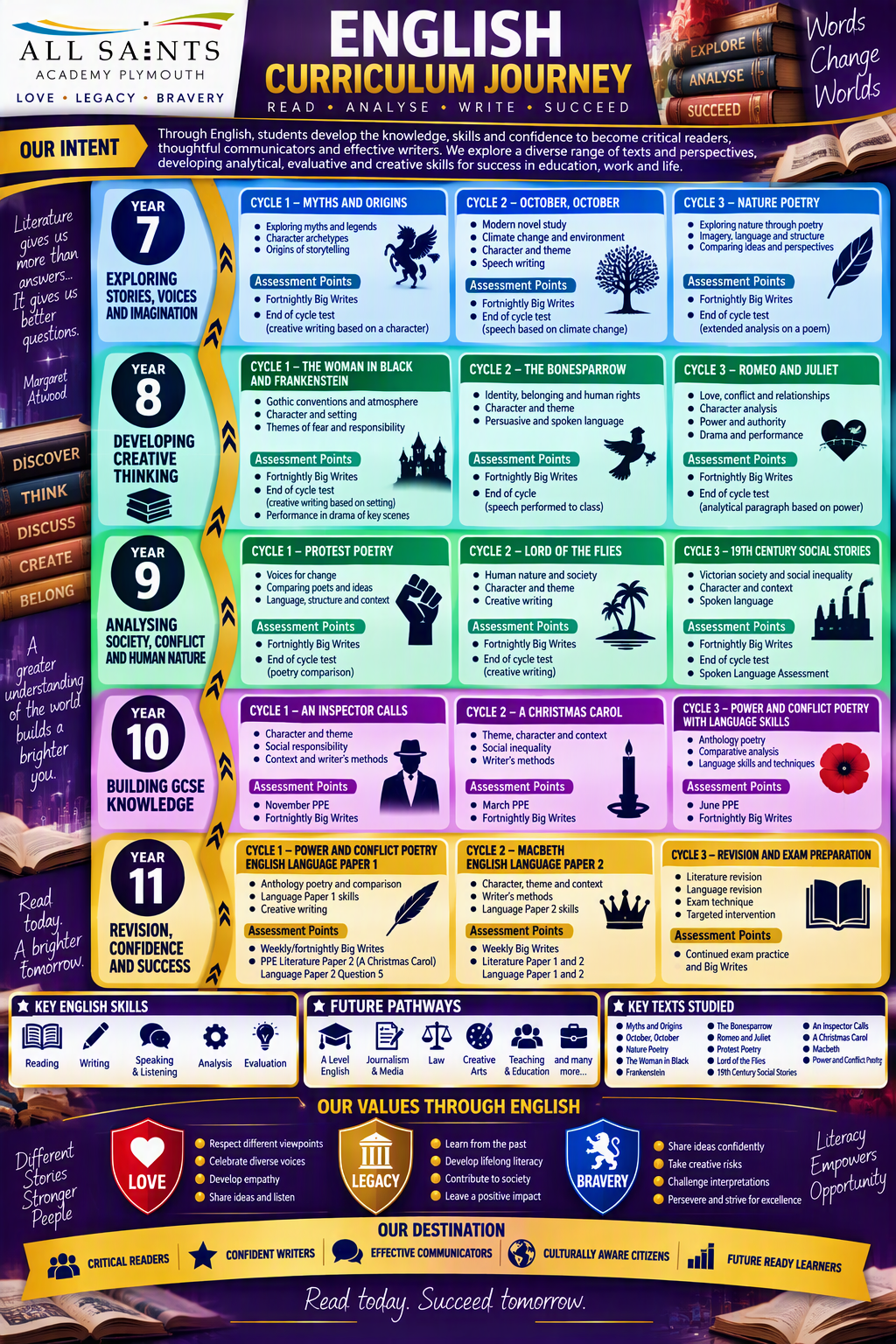
Our curriculum enables students to explore the power of storytelling, language and human experience across different time periods, cultures and genres. From the study of myths, origins and nature in Year 7, through Gothic literature, Shakespeare and modern fiction in Key Stage 3, to the exploration of Victorian literature, modern drama and poetry at GCSE, students develop the knowledge and skills needed to analyse, evaluate and create sophisticated texts.
We believe that English provides students with the tools to understand the world, express their views and challenge ideas with confidence. Through regular opportunities for extended writing, spoken language, creative expression and analytical thinking, students learn how to communicate effectively for different audiences and purposes. Frequent Big Writes, formal assessments and spoken language activities enable students to refine their writing craft, develop resilience and become reflective learners.
The curriculum promotes cultural awareness, empathy and critical literacy by encouraging students to explore important themes such as identity, power, social justice, climate change, morality, conflict and human relationships. Students encounter a rich range of literary voices through texts including October, October, The Woman in Black, Frankenstein, The Bone Sparrow, Romeo and Juliet, Lord of the Flies, An Inspector Calls, A Christmas Carol, Macbeth and the Power and Conflict poetry anthology.
Through the study of English, students at All Saints Academy develop the knowledge, vocabulary and communication skills required for academic success and future employment whilst embodying our core values of Love, Legacy and Bravery. We aim to develop readers who are curious, writers who are purposeful and communicators who are confident, preparing them to make a positive contribution to society and flourish beyond the classroom.
Love
Students explore diverse experiences, cultures and perspectives, developing empathy, compassion and respect for others through literature and language.
Legacy
Students engage with significant literary works and enduring ideas that have shaped society, understanding how language and stories influence the world around them.
Bravery
Students are encouraged to think critically, question assumptions, express their ideas confidently and tackle challenging texts with resilience and determination.
English Curriculum Drivers
- Reading for pleasure and academic success
- Vocabulary development and disciplinary literacy
- Creative and transactional writing
- Spoken language and communication
- Critical analysis and evaluation
- Cultural awareness and social understanding
- Resilience, independence and reflection
- Preparation for GCSE and lifelong learning
Our vision is to develop articulate, thoughtful and confident young people who can read critically, write effectively and communicate powerfully, enabling them to thrive in education, employment and the wider world.
Curriculum Map
Maths
Curriculum Intent
Confident Mathematicians, Creative Problem Solvers
At All Saints, we believe that every student can be successful in mathematics. We reject the idea that some students “just can’t do maths” and instead promote a culture of high expectations, hard work and resilience.
Our aim is to develop confident mathematicians who have the knowledge and skills to solve problems, reason mathematically and apply their learning in unfamiliar situations. We want every student to leave All Saints with the mathematical understanding and qualifications they need to take their next steps with confidence.
What Makes Mathematics at All Saints Special?
Mathematics at All Saints has been on a strong journey of improvement, driven by high expectations for every student and a belief that prior attainment should not place a ceiling on future success.
Our experienced team includes a number of GCSE examiners, giving our teachers an excellent understanding of the demands of GCSE Mathematics and what students need to do to be successful. This expertise informs our teaching throughout Years 7–11, helping students to develop strong mathematical foundations alongside the problem-solving, reasoning and examination skills they will need later.
We are ambitious for all of our students. Those who need additional support are given opportunities to strengthen their mathematical foundations, while students who grasp concepts quickly are challenged to think more deeply, make connections and tackle increasingly complex problems.
Our Curriculum
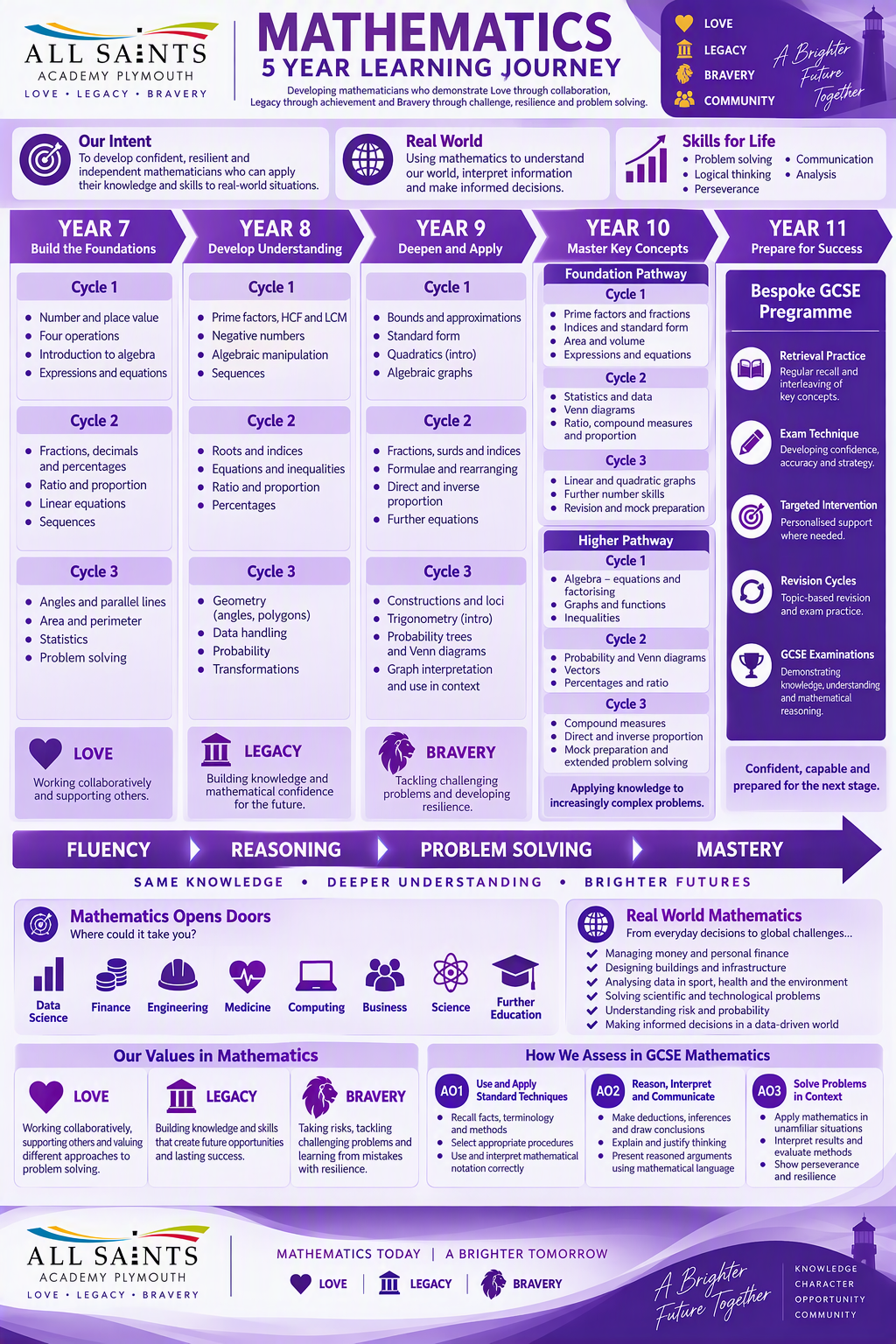
Students follow a carefully sequenced five-year spiral curriculum from Year 7 to Year 11, providing full coverage of the National Curriculum and beyond.
Rather than teaching topics once and moving on, important mathematical ideas are deliberately revisited throughout the five years. Each time students return to a concept, they build upon their previous knowledge and develop a deeper and more connected understanding of mathematics.
Our curriculum is designed so that students:
- continually revisit and strengthen previous learning;
- see connections between different areas of mathematics;
- develop secure and consistent mathematical methods;
- have the prerequisite knowledge needed before encountering new concepts;
- develop fluency alongside mathematical reasoning and problem-solving; and
- are challenged to apply their knowledge in increasingly complex and unfamiliar situations.
Lessons routinely begin by revisiting previous learning. This regular retrieval helps students retain important knowledge over time and ensures that new learning is built upon secure foundations.
Assessment
Assessment is used throughout the curriculum to identify what students know what they have remembered and where further teaching or support is needed.
Students regularly complete retrieval activities and low-stakes checks within lessons alongside more formal assessments at key points during the year. As students progress towards GCSE, examination practice and mock examinations become an increasingly important part of this process.
Teachers use assessment information to identify gaps in knowledge, adapt future teaching and plan appropriate intervention. Students receive feedback that helps them understand their strengths and, importantly, what they need to do next to improve.
Homework
All students complete regular mathematics homework using Sparx Maths.
Sparx provides students with personalised practice that is appropriate to their current level of understanding while continually revisiting previous learning. This supports our spiral curriculum by helping students strengthen recall, practise important mathematical skills and address gaps in their knowledge outside the classroom.
Regular homework is an important part of becoming a confident mathematician. We encourage students to work independently, persevere when questions are challenging and seek support from their teachers when they need it.
Support and Intervention
We recognise that students arrive at All Saints with different experiences and levels of mathematical confidence. Our aim is to ensure that every student has the foundations they need to access the curriculum and make progress.
Alongside support within mathematics lessons, identified students may receive additional opportunities to develop their mathematical fluency and confidence.
These include targeted mathematics work during tutor time, access to DoodleMaths, and additional support through our foundational tutor programme.
Challenge and Enrichment
We want students to see mathematics as a subject to explore and enjoy, as well as a qualification to achieve.
Students have opportunities to take part in Maths Challenge tutor groups and mathematical competitions, such as TWT Exeter Maths Challenge, allowing them to tackle unfamiliar problems, develop their reasoning and experience mathematics beyond the classroom curriculum.
For students who demonstrate a particular strength and interest in mathematics, our curriculum also provides opportunities to study GCSE Statistics and Further Mathematics, extending their mathematical knowledge and helping to prepare them for further study.
Through Axiom Maths, mathematical challenges and our wider curriculum, we aim to develop students who are curious, resilient and willing to tackle problems even when the solution is not immediately obvious.
Preparing Students for Their Next Steps
Ultimately, our ambition is for every student to leave All Saints believing that they can do mathematics.
For some students, mathematics will lead to A Levels, further study and careers involving mathematics, science, technology or engineering. For others, it will provide the essential numeracy, reasoning and problem-solving skills they need for their next stage of education, employment and everyday life.
Whatever their starting point or future destination, we want our students to leave us as confident mathematicians and creative problem solvers, equipped with the knowledge, skills and resilience to succeed.
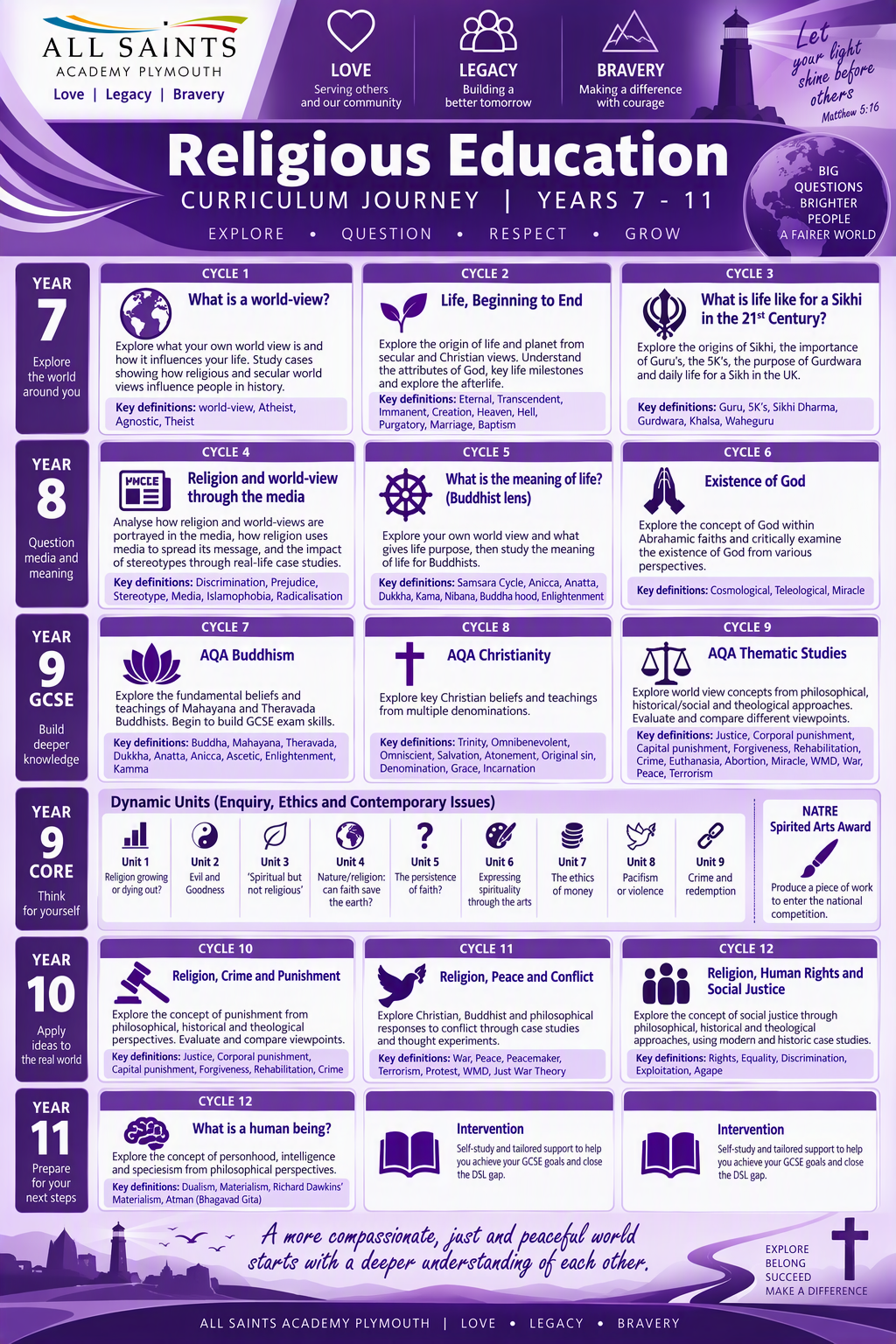
Religious Studies
Curriculum Intent:
The curriculum is much more than just lessons. It includes the ethos, attitudes and relationships which create a high quality of life in all of our schools. Our aim is to provide a broad, balanced and rigorous curriculum that meets the needs and aspirations of every young person and leaves them well-prepared for their future.
The Religious Studies curriculum ensures all students are systematically prepared for the spiritual and intellectual challenges of living in a world with diverse religions and beliefs as well as non-beliefs. That as members of society, they can confidently and coherently articulate their beliefs, ideas and values. Whilst demonstrating mutual respect, tolerance and appreciation of all aspects of diversity.
The curriculum intends:
- To encourage students to explore their own world-view (whether they are religious or non-religious), in the light of what they learn, as they examine issues of religious belief and faith and how these impact on personal, institutional and social ethics; and to express their responses.
- To develop students’ knowledge and understanding of Christianity and other principal religions, fostering personal reflection and spiritual development
- To enable students to build their sense of identity and belonging, to help them flourish within their communities and as citizens in a diverse society.
- To challenge stereotypes and build resilience to anti-democratic or extremist narratives.
- To cultivate respect for others, including people with different faiths and beliefs, to challenge prejudice.
- To consider their responsibilities to themselves and to others, and to explore how they might contribute to their communities and to wider society. It encourages empathy, generosity and compassion.
Curriculum Map
Science
Curriculum Intent
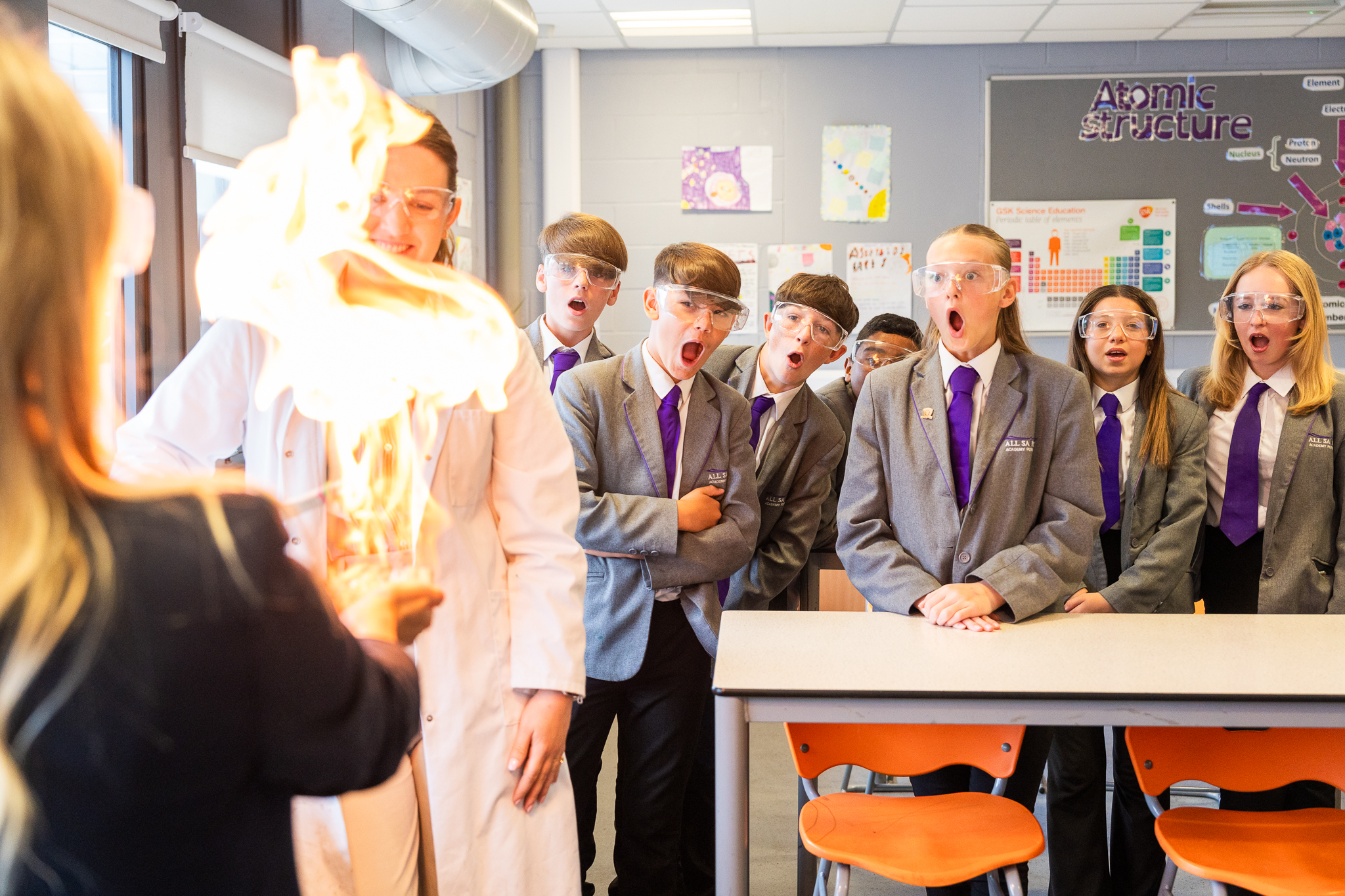
At All Saints Academy, we believe that science helps students to understand the world around them and their place within it. Our curriculum is designed to develop knowledgeable, inquisitive and confident young people who can think critically, ask questions and use evidence to reach informed conclusions.
Rooted in our values of Bravery, Love and Legacy, the science curriculum encourages students to embrace challenge, show curiosity and develop the resilience needed to succeed. We want students to be brave enough to question ideas, learn from mistakes and persevere when faced with complex scientific concepts.
Through the study of biology, chemistry and physics, students build a secure understanding of key scientific principles whilst developing the practical skills required to work scientifically. Knowledge is carefully sequenced so that students can build on prior learning, make meaningful connections between topics and retain important concepts over time.
We foster a love of science by providing engaging lessons, practical investigations and opportunities for students to explore how science affects their everyday lives. Students learn about significant scientific discoveries, the contributions of scientists from a range of backgrounds and the role science plays in tackling issues such as climate change, healthcare and sustainability.
We are committed to creating a lasting legacy for our students. Our curriculum equips them with the scientific literacy, problem-solving skills and confidence they need to progress into further study, employment and an increasingly scientific and technological world. Whether pursuing careers in STEM or applying scientific thinking in other fields, students leave All Saints Academy prepared to make informed decisions and contribute positively to their communities.
By the end of Key Stage 4, students will have developed the knowledge, skills and character needed to embody the values of Bravery, Love and Legacy, enabling them to succeed in further education, future employment and life beyond All Saints Academy.
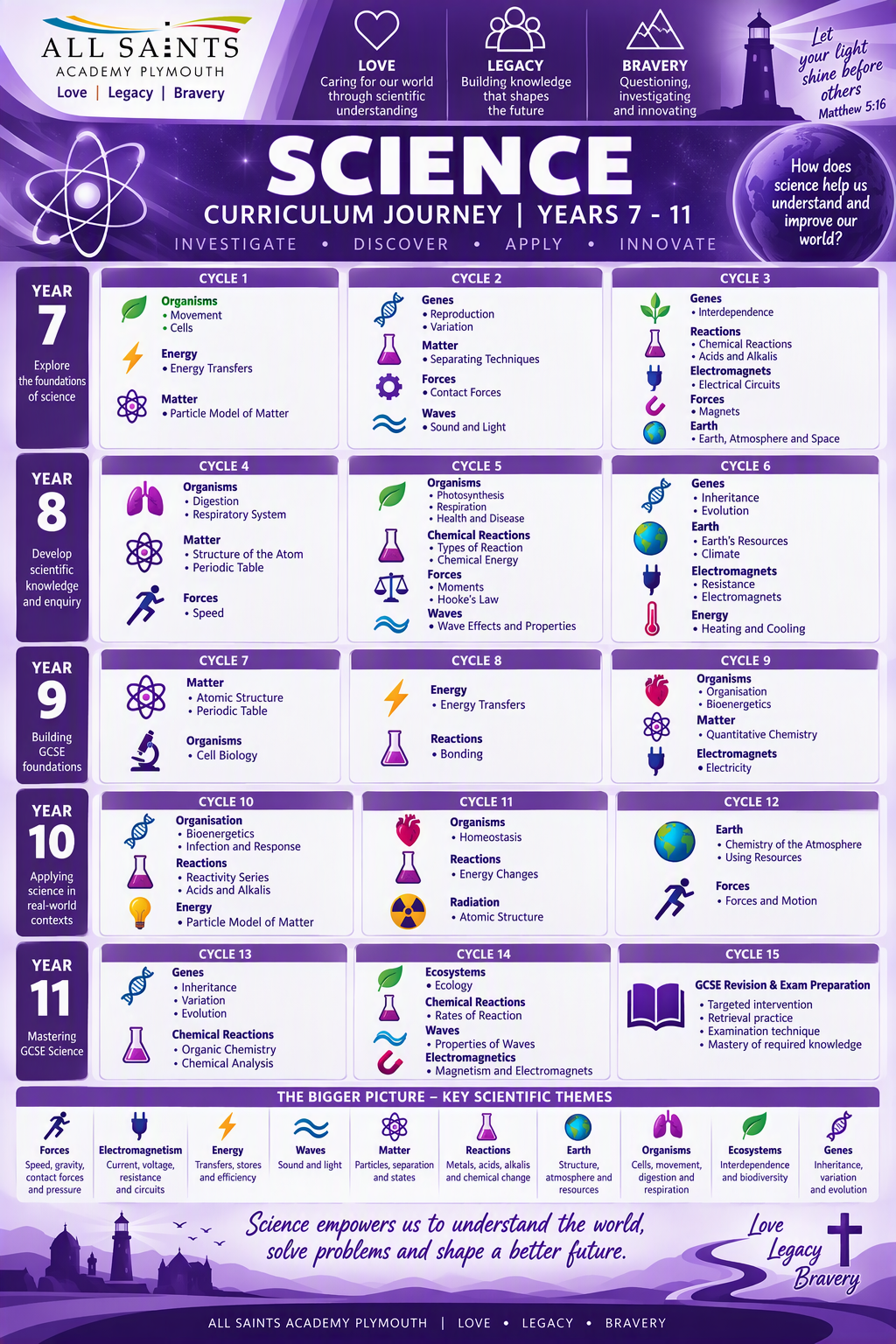
Curriculum Map
Wider Subject Curriculum Overviews:
Art
Curriculum Intent
At All Saints Academy Plymouth, the Art & Design curriculum inspires students to become creative, confident and reflective individuals who understand the power of visual communication and artistic expression. Through the exploration of diverse artists, cultures, movements and materials, students develop the knowledge, technical skills and creative confidence needed to express ideas, communicate meaning and engage with the world around them.
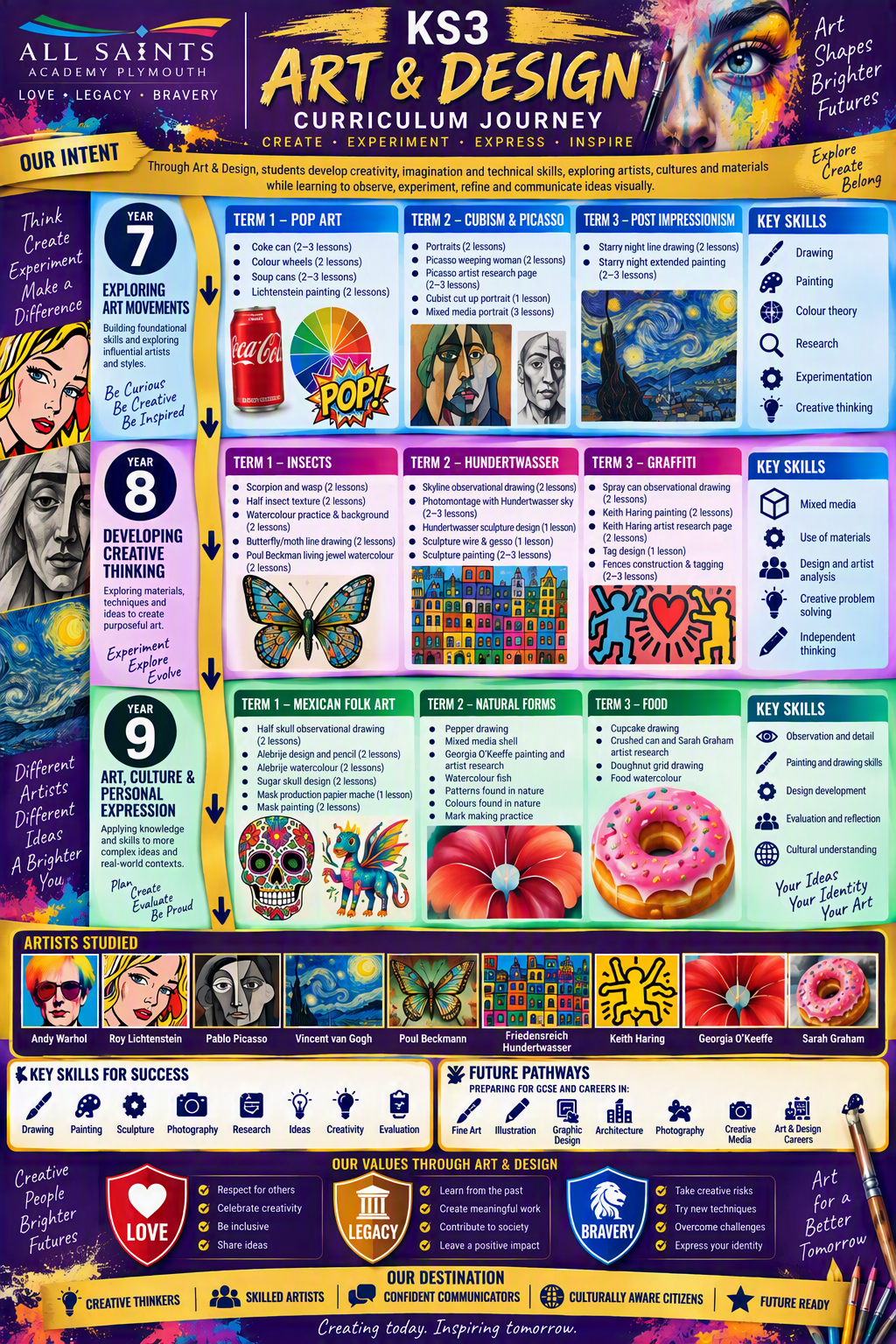
The curriculum is carefully sequenced to build skills progressively across Key Stage 3 and into Key Stage 4. Students begin by exploring significant artistic movements such as Pop Art, Cubism and Post-Impressionism, developing foundational skills in drawing, painting, colour theory and artist analysis. As they progress, students encounter increasingly challenging projects inspired by a broad range of artists and cultural traditions, including natural forms, Mexican Folk Art, graffiti, sculpture and mixed media techniques.
Students are encouraged to experiment, take creative risks and develop their own artistic voice. Through observational drawing, painting, sculpture, research, design development and evaluation, they learn how artists communicate ideas and respond to the world around them. The curriculum promotes curiosity, cultural awareness and appreciation of both historical and contemporary art practices.
Throughout their learning journey, students develop resilience, independence and critical thinking skills by refining work, responding to feedback and evaluating creative outcomes. They learn to make informed artistic decisions, solve problems creatively and present work with confidence and pride.
At GCSE Fine Art, students build upon these foundations through personal investigations, sustained projects, artist research and experimentation with a range of media. They develop increasingly independent approaches to creativity, preparing them for further education, employment and future careers within the creative industries.
The Art & Design curriculum reflects the values of Love, Legacy and Bravery by encouraging students to respect diverse perspectives, learn from artists and cultures across time, and confidently take creative risks while developing their own unique identities as artists.
Intended Impact
By the end of their Art & Design journey, students will:
- Demonstrate strong observational, drawing and creative skills.
- Understand and appreciate a wide range of artists, cultures and artistic movements.
- Experiment confidently with materials, techniques and processes.
- Develop creativity, imagination and personal expression.
- Analyse, evaluate and refine their work independently.
- Communicate ideas visually and effectively.
- Show resilience, confidence and independence when tackling creative challenges.
- Develop a lifelong appreciation of art, culture and creativity.
- Be well-prepared for further study and careers within the creative and cultural sectors.
Students leave All Saints Academy as creative thinkers, skilled artists, confident communicators and culturally aware citizens, equipped with the confidence and imagination to contribute positively to a rapidly changing and increasingly creative world.
KS3 Curriculum Map
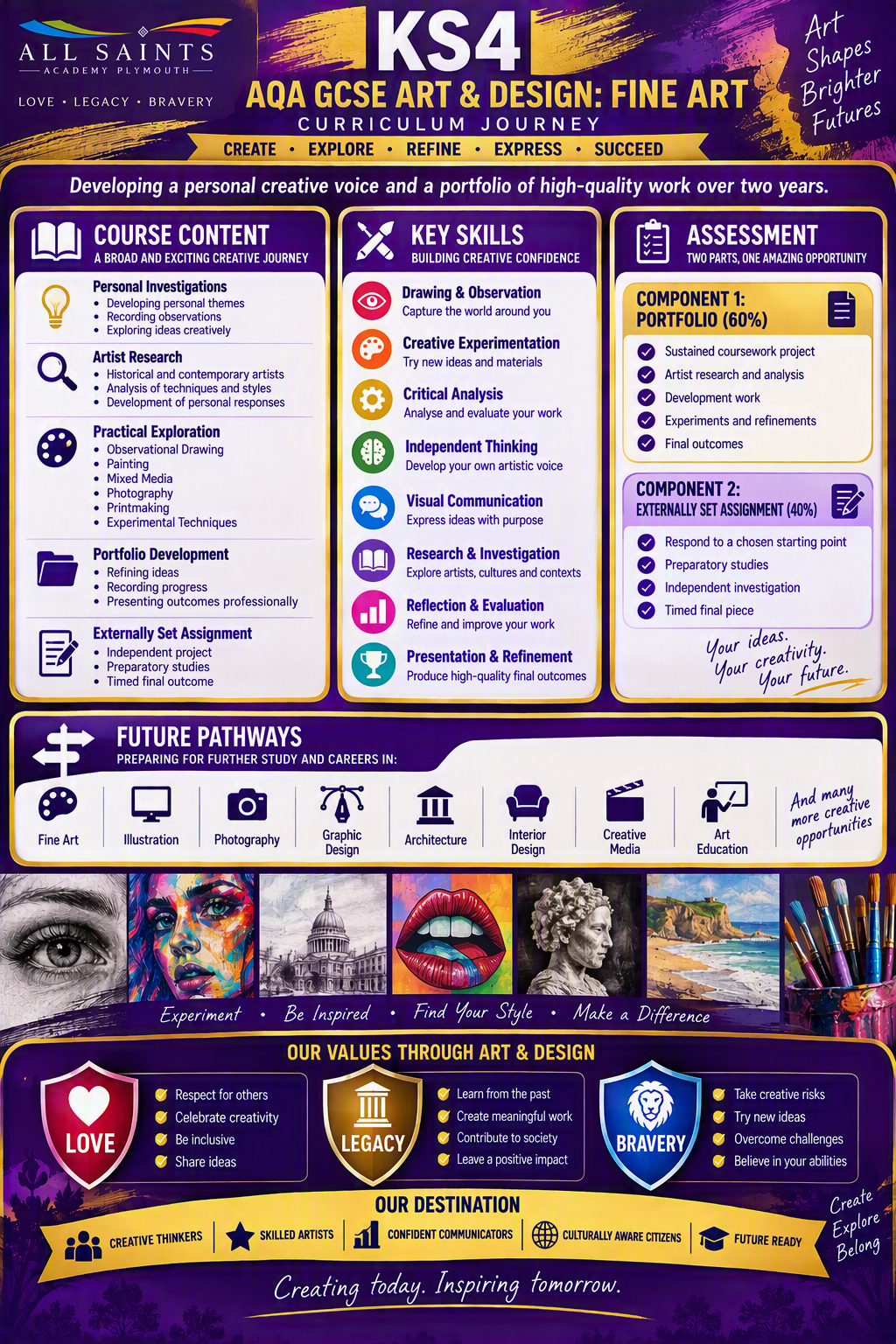
KS4 Curriculum Map
French
Curriculum Intent
The curriculum is much more than just lessons. It includes the ethos, attitudes and relationships which create the high quality life in all of our schools. Our aim is to provide a broad, balanced and rigorous curriculum that meets the needs and aspirations of every young person and leaves them well-prepared for their future.
The Modern Foreign Language curriculum is planned to ensure that students acquire a variety of competences in communication and a knowledge of other cultures. They will also develop confidence and motivation towards a brighter future.
Les langues offrent une variété de compétences dans la communication et dans la connaissance d’autres cultures. Elles développent l’inspiration, la confiance et la motivation pour un futur plus prometteur.
The curriculum intends:
- To foster positive attitudes, interest, and enthusiasm for languages
- To give awareness of the cultures of the countries of the languages studied
- To raise awareness of the nature of language and the process of language learning
- To achieve communicative confidence and competence in the language
- To offer students a range of activities to explore language
- To provide enjoyment and intellectual stimulation, which may encourage students to continue their study of the language
- To ensure that all students make minimum expected progress from Year 7 to 11 (where applicable)
- To encourage students in their whole school career
MFL Extra-Curricular Offer:
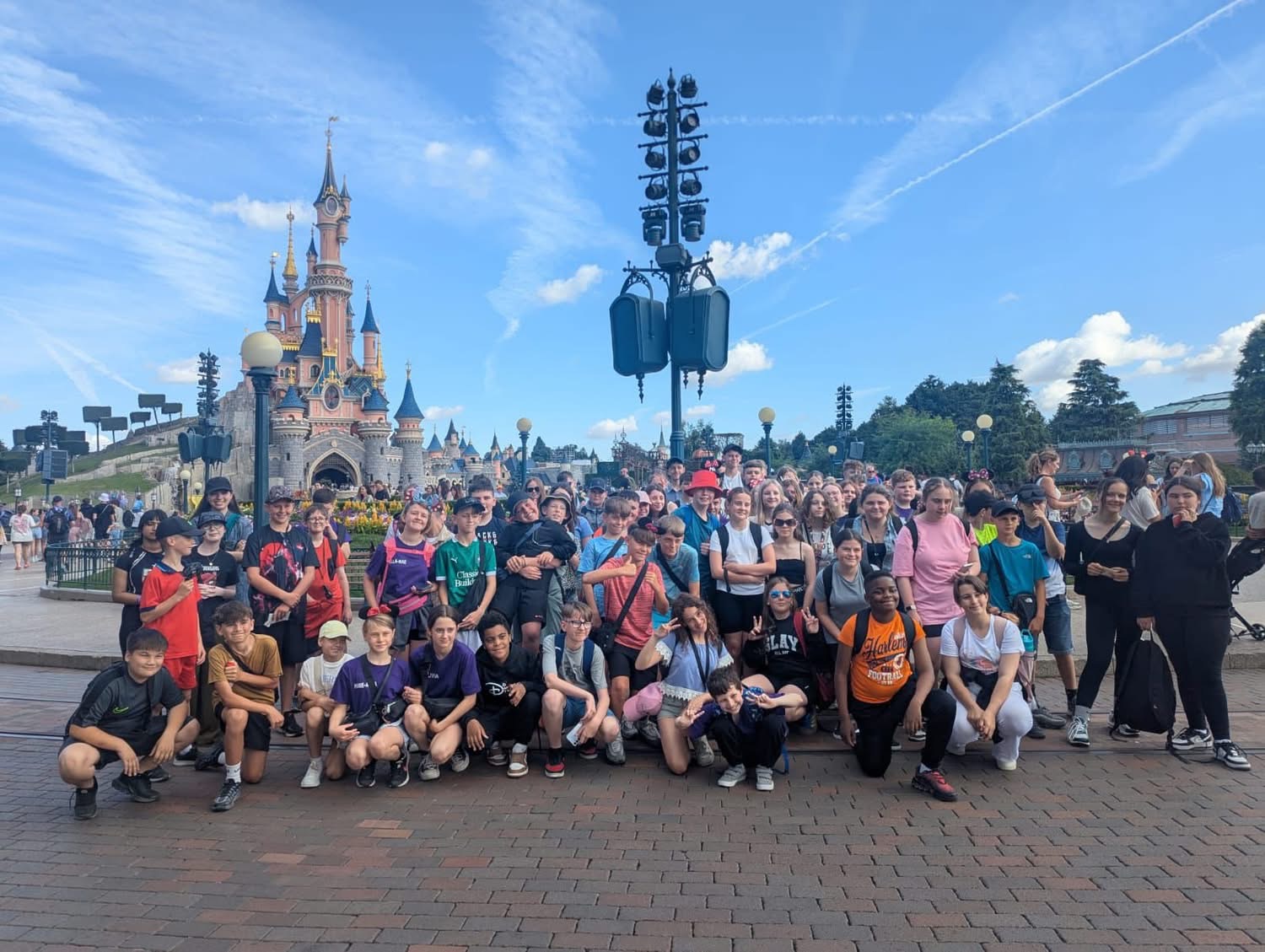
- All Year 7 students are given the opportunity to take part in a residential trip to Paris to immerse themselves in the French language and culture. Students spend four days in the French capital experiencing the wonders of the city and learning about its heritage and influence.
- GCSE students have the opportunity to attend the Paris trip as part of their work experience, where they are expected to support younger students on the trip as well as communicate in French with local people as well as service providers.
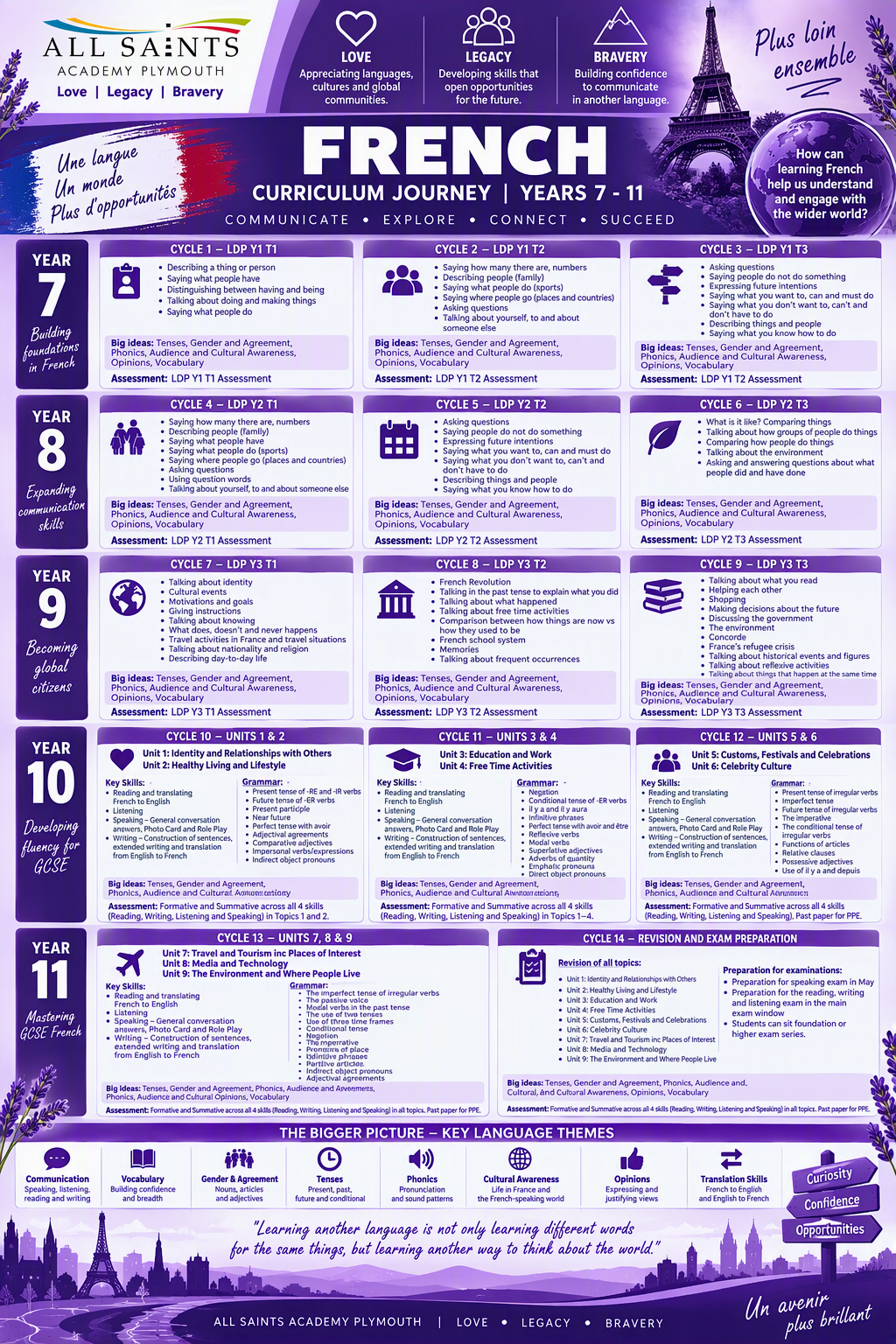
Curriculum Map
Geography
Curriculum Intent
The Geography curriculum is designed to provide a broad, balanced, and ambitious education that develops students’ understanding of the world and their place within it. Through a knowledge-rich and carefully sequenced curriculum, students gain a deep understanding of physical and human geography, global interdependence, and the relationships between people, places, and environments.
At Key Stage 3, students build secure foundational knowledge and geographical skills, including map work, data interpretation, and fieldwork, fostering curiosity about diverse places and landscapes. At Key Stage 4, students extend and apply this knowledge to complex geographical issues, developing critical thinking, informed decision-making, and an understanding of contemporary global challenges.
The curriculum equips students with the geographical knowledge, skills, and cultural awareness needed to succeed in further education, employment, and life as informed and responsible global citizens.
The curriculum intends:
- To foster positive attitudes, interest, and enthusiasm for Geography
- To give awareness of the cultures of the countries and processes of the world
- To understand enquiry is an approach to teaching and learning geography and not simply a set of investigative skills.
- To provide students with an understanding of learning and how they learn is inextricably linked.
- To understand that students' learning is influenced by the knowledge they bring to the classroom – students have their own varied personal geographies.
- To offer students a range of activities to explore both human and physical Geography.
- To provide enjoyment and intellectual stimulation, which may encourage students to continue their study of Geography.
- To ensure that all students make minimum expected progress from Year 7 to 11 (where applicable).
- To encourage students throughout their whole school career.
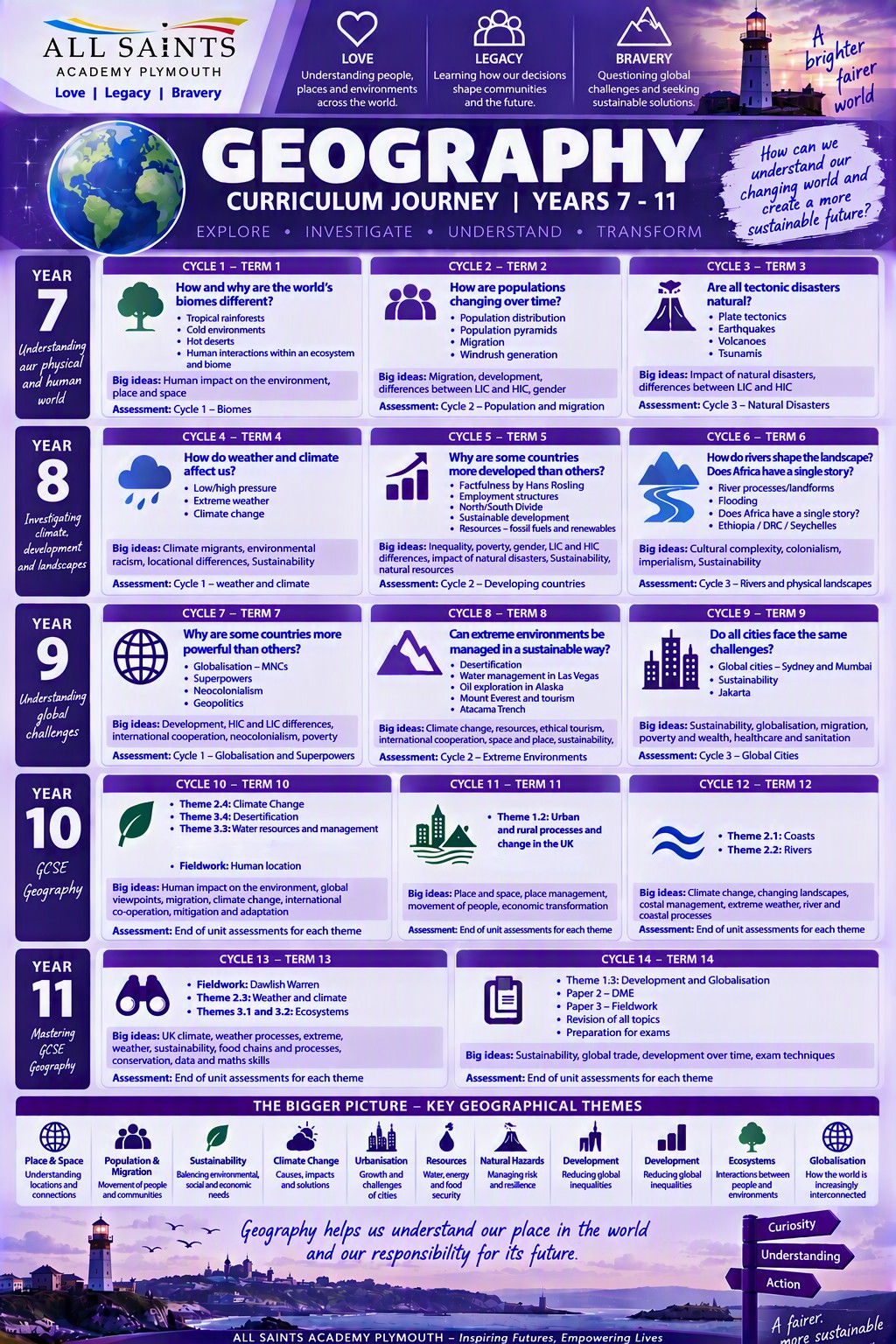
Curriculum Map
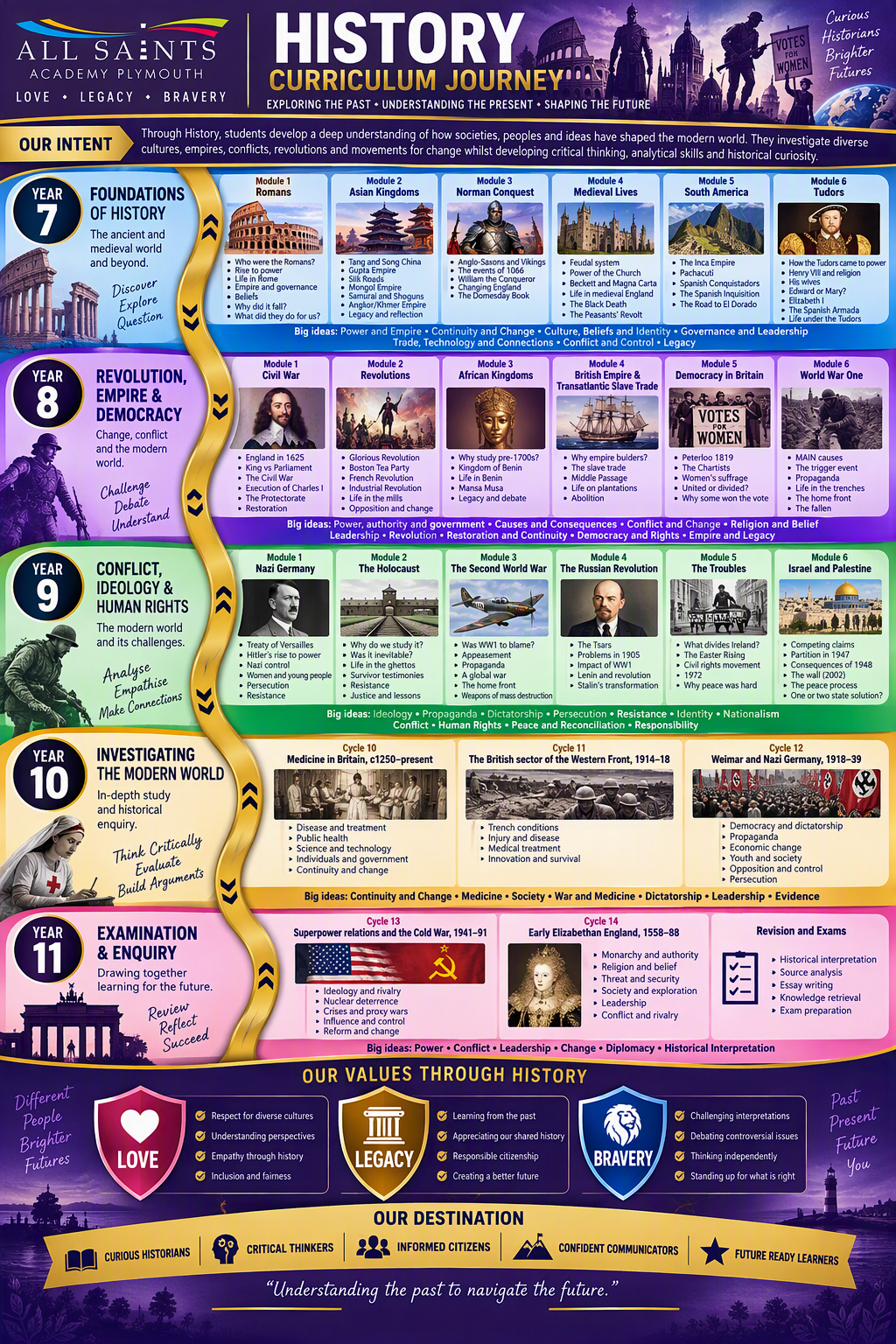
History
Curriculum Intent
What do we do?
History is the study of how historians use sources to construct a picture of the past. Through this process, students develop critical thinking and an appreciation for the contested nature of historical knowledge. Our curriculum fosters this disciplinary understanding while helping pupils make sense of the world around them. By exploring how societies, institutions, and ideas have changed over time, students gain insight into their identities as local, national, and global citizens.
What skills and cultural capital do students gain in history?
Our curriculum develops students’ historical literacy, including critical thinking, evidence evaluation, and the ability to construct and critique interpretations. They engage with second-order concepts such as causation, change, and significance, learning to think like historians. Exposure to a wide range of scholarship and diverse global narratives builds cultural capital, challenges stereotypes, and broadens perspectives – fostering a deeper understanding of identity, society, and democracy.
How is the history curriculum designed?
Our KS3 curriculum follows a broadly chronological structure, helping students understand change and continuity over time. Key substantive concepts (such as revolution, empire, and the Church) are revisited across different contexts to build deep, residual knowledge. Rather than frontloading GCSE content, we focus on cultivating the disciplinary habits of historians. This approach prepares students not only for academic success but also for critical engagement with the world around them.
Curriculum Map
PE
Curriculum Intent
At All Saints Academy, our Physical Education curriculum is designed to inspire all students to lead healthy, active and fulfilling lives through meaningful engagement in physical activity, sport and physical recreation. We believe that Physical Education plays a vital role in developing the whole child and provides students with the knowledge, skills and attitudes required to thrive both within and beyond school.
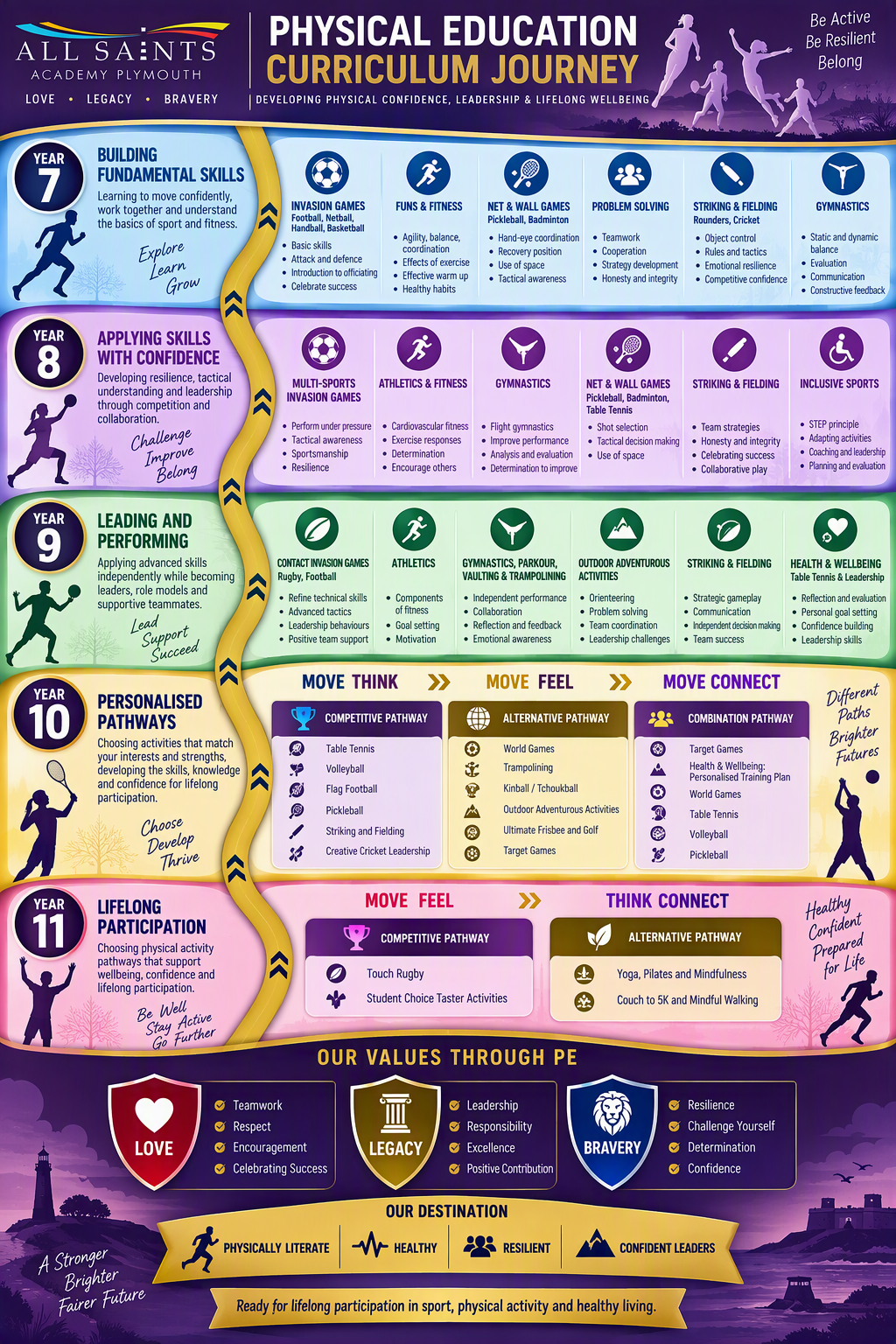
Our curriculum is underpinned by the PE Scholar Move, Think, Feel and Connect model and informed by the work of Oak National Academy. This framework recognises that high-quality Physical Education extends far beyond physical performance and should support students' physical, cognitive, social and emotional development. Through carefully sequenced learning experiences, students develop not only competence in movement but also the ability to think critically, regulate emotions, build positive relationships and understand the lifelong benefits of participation in physical activity.
Move
Students develop a broad range of movement skills, physical competencies and tactical understanding across a variety of activity areas. They are encouraged to improve their fitness, coordination, balance, agility and overall physical literacy, enabling them to participate confidently and successfully in a range of sports and activities.
Think
Students are challenged to make decisions, solve problems, analyse performance and apply strategies within competitive and non-competitive environments. Through reflection and evaluation, they develop resilience, creativity and an understanding of how knowledge can be transferred across different physical contexts.
Feel
Physical Education provides opportunities for students to develop confidence, self-esteem, determination and emotional resilience. Students learn how physical activity can positively impact mental wellbeing and are encouraged to embrace challenges, cope with setbacks and celebrate personal progress.
Connect
Students learn the importance of teamwork, communication, leadership, empathy and respect. Through collaborative experiences, they build positive relationships with others and develop the social skills necessary to contribute successfully to their communities both now and in the future.
Our curriculum is broad and balanced, ensuring students experience a diverse range of activity areas including invasion games, net and wall games, striking and fielding activities, athletics, gymnastics, dance, fitness and outdoor learning experiences where appropriate. This breadth enables students to discover activities they enjoy while developing competence across multiple domains of physical education.
In Years 7 and 8, students are taught in mixed-sex Physical Education groups. This reflects our commitment to equality, inclusion and mutual respect. Learning together helps to challenge gender stereotypes, promotes positive social interaction and enhances communication and collaboration skills between students. Through shared experiences, students learn to value individual strengths and support one another's development.
As students’ progress into Years 10 and 11, they are provided with greater choice through two distinct pathways:
- Competitive Pathway: Designed for students who enjoy traditional sports and competitive performance, providing opportunities to refine skills, tactics and game understanding within a range of competitive activities.
- Alternative Pathway: Designed for students who may prefer participation-focused, health-related or lifestyle activities, helping them develop confidence, enjoyment and long-term engagement in physical activity beyond school.
Through both pathways, all students continue to develop the knowledge, skills and confidence required to maintain active and healthy lifestyles into adulthood.
Ultimately, the Physical Education curriculum at All Saints Academy Plymouth aims to develop physically literate, emotionally resilient, socially responsible and confident young people who understand the value of physical activity and are equipped with the motivation, competence and knowledge to participate in sport and physical activity throughout their lives.
Curriculum Map:
PSHE
Curriculum Intent – PSHE and RSE
At All Saints Academy, our Personal, Social, Health and Economic (PSHE) and Relationships, Sex and Health Education (RSHE) curriculum is designed to develop knowledgeable, resilient and compassionate young people who are equipped to flourish in modern Britain and beyond. Through a broad, ambitious and inclusive curriculum, we prepare students for the opportunities, responsibilities and challenges of adult life whilst supporting their personal development, wellbeing, character and academic success. The curriculum is informed by the 2026 PSHE Association Programme of Study for PSHE Education (Key stages 3–4), and reflects the statutory requirements for Relationships, Sex and Health Education alongside the wider principles of safeguarding, citizenship, economic wellbeing and personal development.
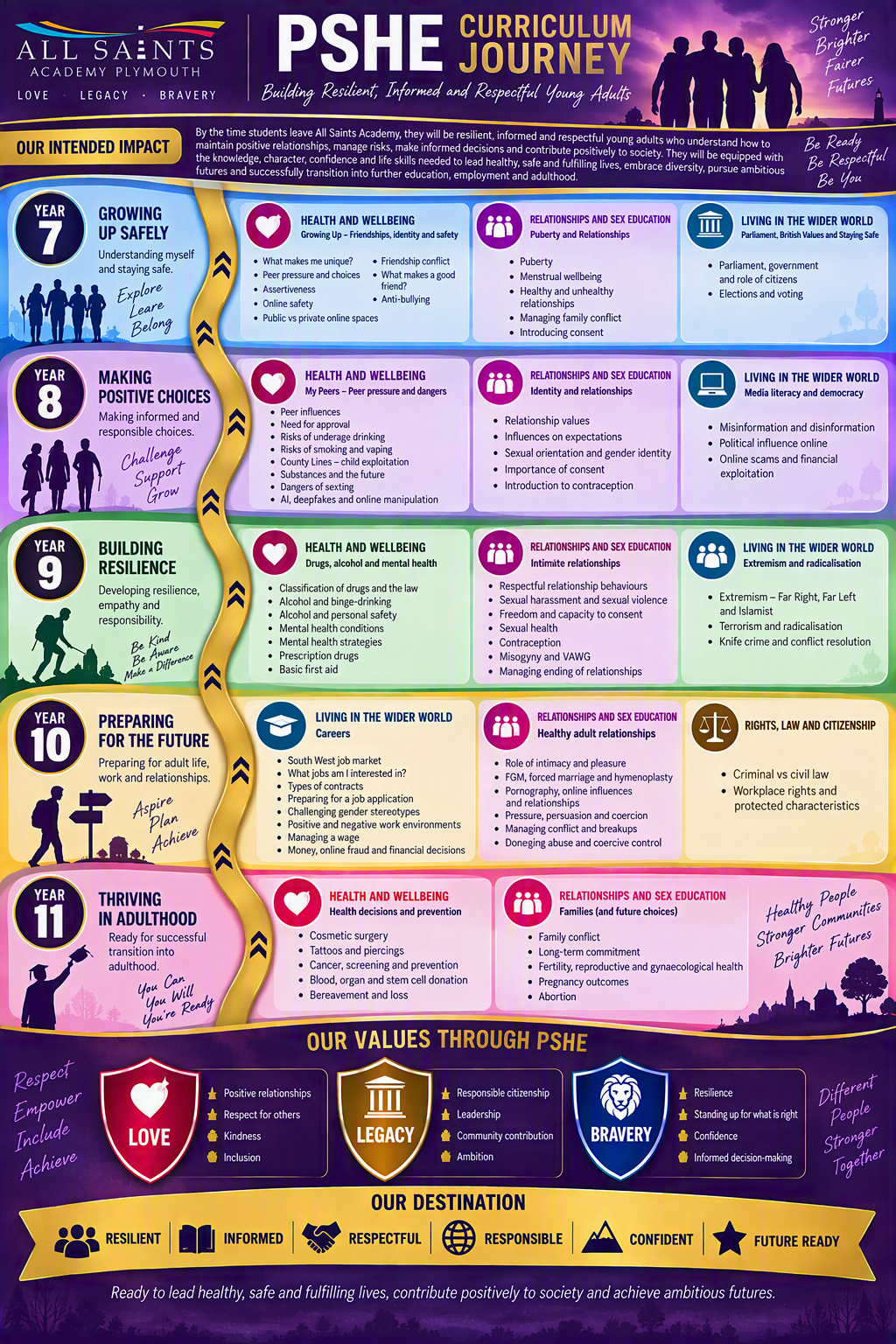
Our curriculum is carefully sequenced from Years 7 to 11, enabling students to revisit, deepen and apply their learning as they grow in maturity, independence and confidence. Through a spiral curriculum, students develop the knowledge, skills and attributes required to make informed decisions, manage risk, build positive relationships and contribute positively to society. The curriculum is designed to respond to the realities of young people's lives today, including the influence of social media, artificial intelligence, online misinformation, financial pressures, exploitation, unhealthy relationships and evolving societal issues.
We believe that PSHE and RSHE education should empower all students to:
- Develop a positive sense of self, recognising their strengths, values, aspirations and potential.
- Understand and maintain positive mental health and emotional wellbeing, developing strategies to cope with challenge, adversity, loss and change.
- Make informed decisions about their physical health, including healthy lifestyles, substance misuse, sexual health and personal safety.
- Build healthy, respectful and positive relationships founded upon kindness, consent, equality, trust and mutual respect.
- Recognise, challenge and report harmful behaviours, including bullying, discrimination, sexual harassment, coercive control, exploitation and violence against women and girls.
- Understand and respect diversity in all its forms and contribute positively to a tolerant, inclusive and equitable society.
- Navigate the online world safely and critically, understanding online relationships, misinformation, deepfakes, artificial intelligence, digital manipulation and the risks associated with social media.
- Recognise the dangers of exploitation, county lines, extremism, radicalisation, knife crime and other safeguarding risks, knowing when and how to seek support.
- Develop financial literacy and economic wellbeing, enabling them to make informed decisions about money, budgeting, debt, scams, fraud and future financial responsibilities.
- Develop employability skills and explore future education, training and career pathways, challenging stereotypes and raising aspirations for their future.
- Understand democracy, rights, responsibilities and active citizenship, enabling them to contribute positively to their local, national and global communities.
Our PSHE and RSHE curriculum reflects the Christian values of dignity, respect, compassion, justice and service. We recognise the inherent worth of every individual and seek to create a culture where all students feel valued, respected and included. Through learning about different experiences, beliefs and perspectives, students develop empathy, understanding and respect for others within our diverse society.
We are committed to creating a safe learning environment where students can discuss sensitive issues respectfully, challenge misconceptions and develop the confidence to seek support when needed. Learning is adapted to meet the needs of our students and is informed by safeguarding priorities, local context, student voice and emerging societal issues. Through close partnership with families, external agencies and the wider community, we aim to ensure that all students receive high-quality, relevant and meaningful PSHE education.
Curriculum Principles
Our PSHE and RSHE curriculum is:
Inclusive
We celebrate diversity and ensure that all students feel represented, respected and valued. The curriculum reflects a broad range of experiences and promotes equality, inclusion and belonging.
Knowledge-Rich
Students are taught accurate, up-to-date and evidence-informed knowledge that enables them to understand themselves, others and the world around them.
Safeguarding-Focused
Students develop the knowledge and skills required to recognise risk, stay safe, seek help and support the wellbeing of themselves and others.
Responsive
Our curriculum evolves to reflect emerging issues affecting young people, including online harms, artificial intelligence, exploitation, financial wellbeing and changing social influences.
Preparing for Adulthood
Students develop the resilience, character, employability, financial capability and decision-making skills required to thrive in further education, employment and adult life.
Intended Impact
By the time students leave All Saints Academy, they will be resilient, informed and respectful young adults who understand how to maintain positive relationships, manage risks, make informed decisions and contribute positively to society. They will be equipped with the knowledge, character, confidence and life skills needed to lead healthy, safe and fulfilling lives, embrace diversity, pursue ambitious futures and successfully transition into further education, employment and adulthood.
Curriculum Map
Technology (KS3)
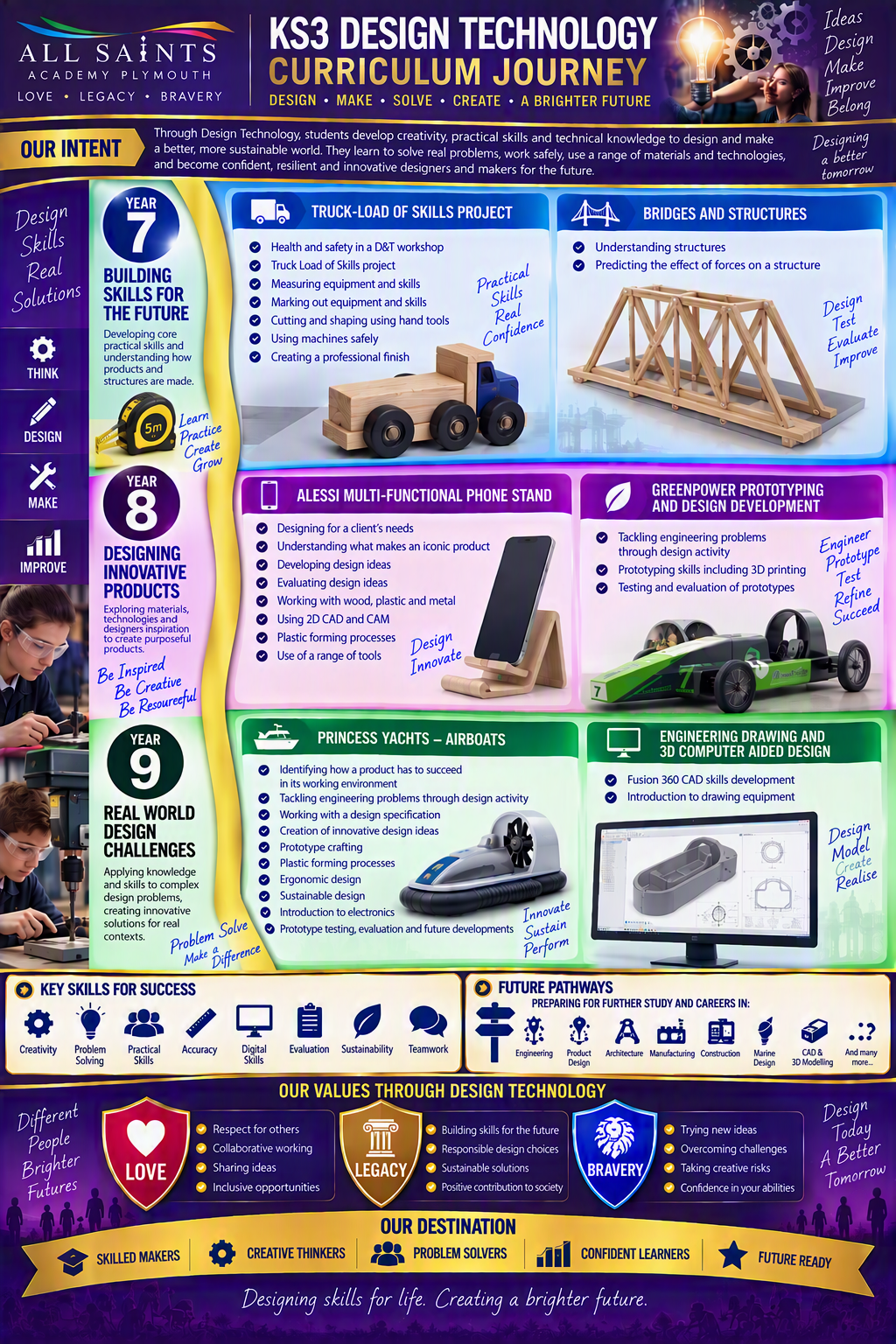
Design Technology at KS3
Curriculum Intent:
The curriculum is much more than just lessons. It includes the ethos, attitudes and relationships which create a high quality life in all of our schools. Our aim is to provide a broad, balanced and rigorous curriculum that meets the needs and aspirations of every young person and leaves them well-prepared for their future.
The curriculum intends to:
Prepare students to face the challenges of an ever-modernised world. Develop the ability to solve technical problems and use creative and innovative thinking to design and develop products. Prototype products demonstrating a wide range of transferable practical skills. To be able to assess the effectiveness of a solution and its impact on the environment. Allow students to thrive in successful careers in our local labour market.
Key Knowledge |
Key Skills |
|
Key Threshold Concepts In line with the national curriculum for design and technology, we aim to ensure that all pupils:
Subject specific Knowledge – Pupils will know:
|
Cross –Curricular Knowledge
|
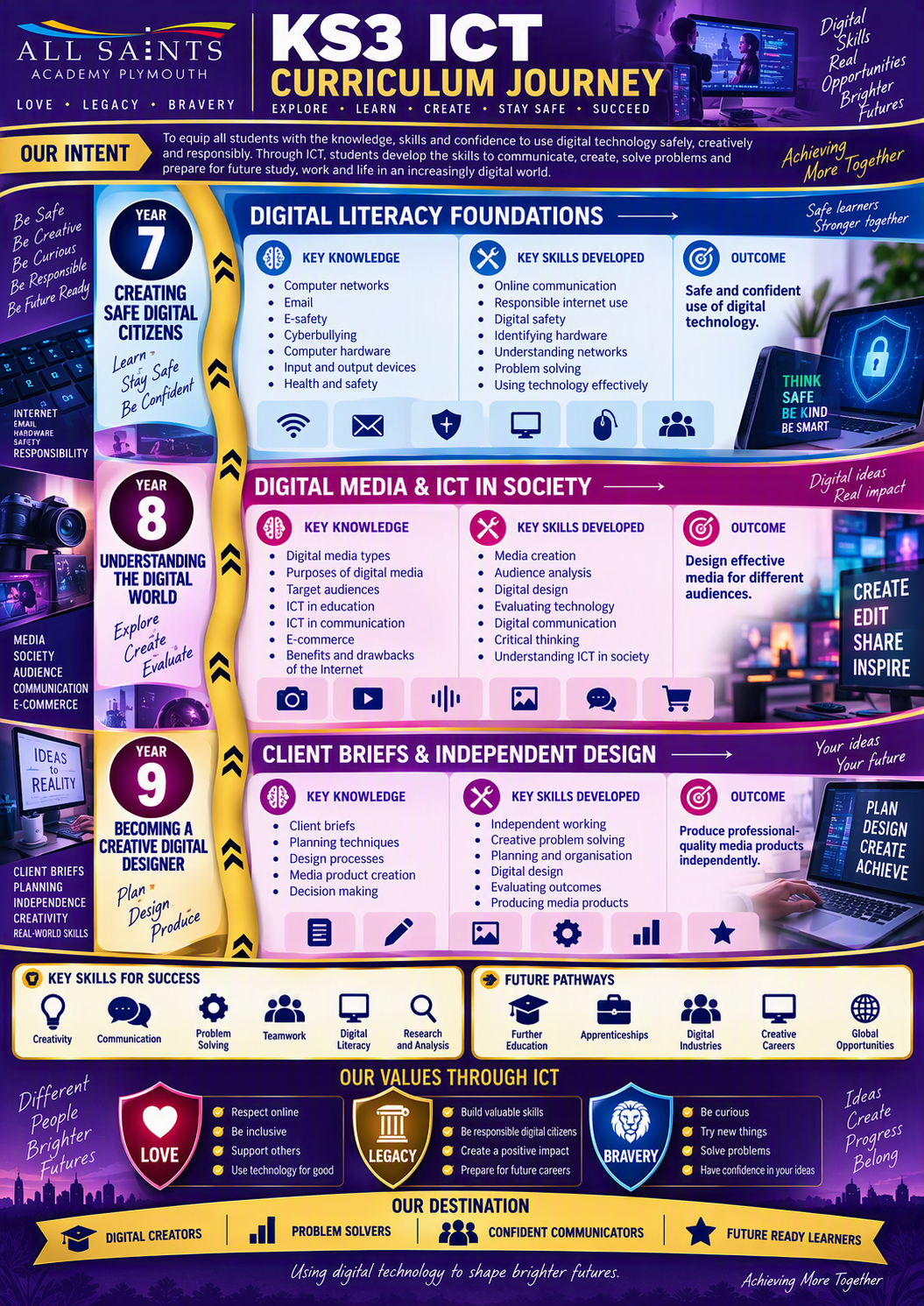
ICT at KS3
Curriculum Intent:
With ICT playing a key part in student’s lives, they will be taught how to become digitally literate, through being taught how to become aware of their digital footprint and how to manage it. Students will learn basic ICT skills using a range of software applications which they will develop across the key stage, leading to becoming independent users of ICT. Students will be encouraged to become responsible, positive and safe users of ICT, leading to an enthusiasm for creating a range of digital media products and wanting to continuously develop their ICT skills.
The curriculum intends:
- to provide a high quality ICT education that equips students to become digitally literate in order to be able to use, express themselves and develop their ICT skills across a range of software applications
- to enable students to become aware of their digital footprint, to enable them to make informed decisions on their use of ICT
- to help raise students' awareness of the use of ICT within society in order to enable them to develop an understanding of the benefits/drawbacks and the need for continued development of ICT to keep pace with user demands
- to equip students with the skill set and confidence to independently develop their ICT skills through the creation of a wide range of digital media products for a specified purpose and target audience
Curriculum Map
Food Technology at KS3
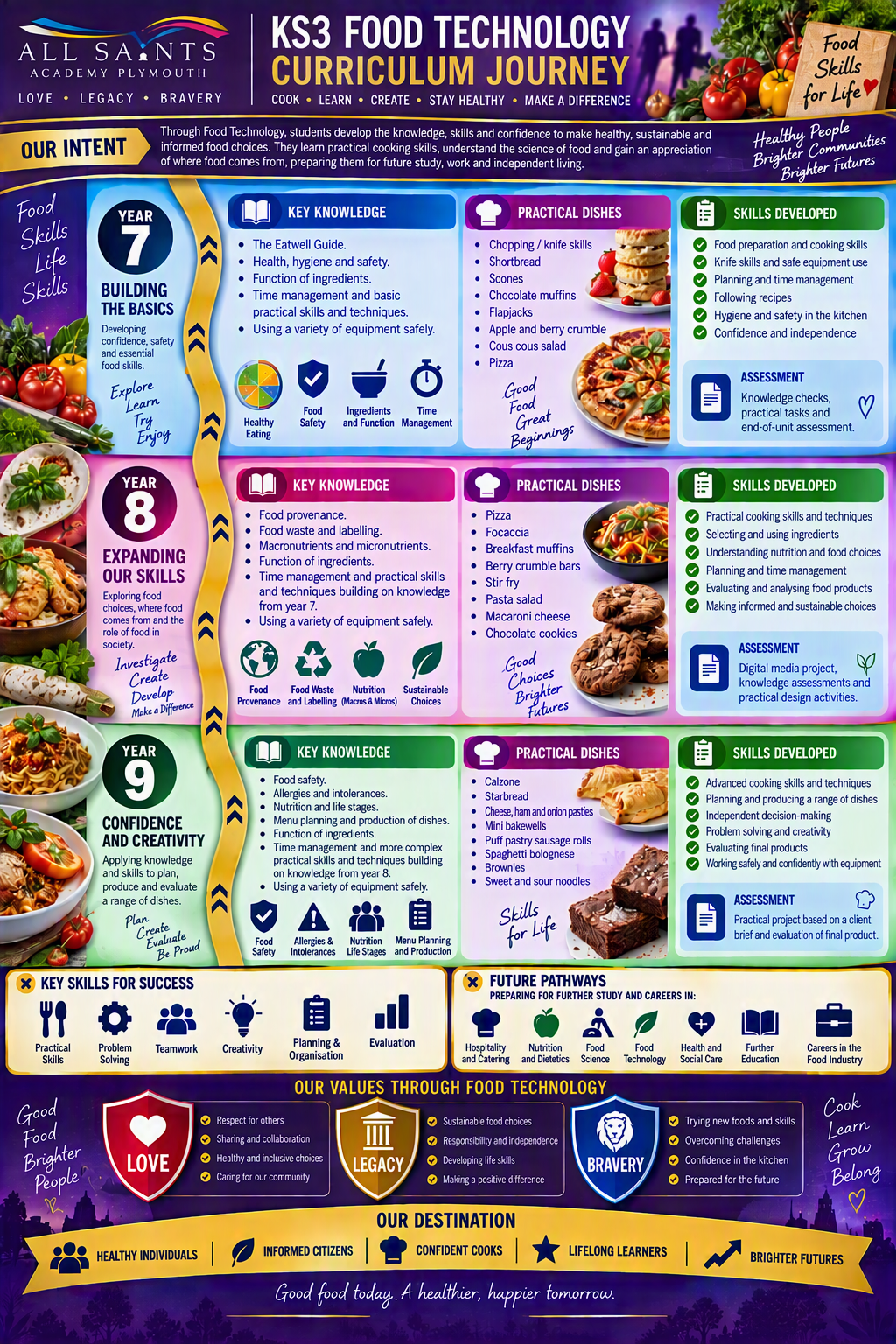
Curriculum Intent:
At All Saints Academy Plymouth, the KS3 Food Technology curriculum empowers students to develop the knowledge, practical skills and confidence needed to make informed food choices and lead healthy, independent lives. Through a combination of nutrition education, food science and practical cookery, students learn how food contributes to health and wellbeing whilst developing essential life skills that will support them beyond the classroom.
The curriculum provides a carefully sequenced journey from foundational skills in Year 7 through to increasingly complex practical techniques and nutritional understanding in Year 9. Students develop a secure understanding of the Eatwell Guide, health, hygiene and food safety, before exploring food provenance, nutrition, food waste, sustainability, allergies, intolerances and the nutritional requirements of different life stages.
Practical cooking is at the heart of the curriculum. Students progressively build their confidence through a broad range of dishes and techniques, developing knife skills, food preparation methods, baking, cooking and presentation skills. Throughout the curriculum, students learn to manage their time effectively, use equipment safely and apply their understanding of the functions of ingredients to produce successful dishes.
Students are encouraged to think creatively, evaluate their work critically and solve problems independently while developing resilience, teamwork and organisational skills. By understanding where food comes from, how food choices impact health and the environment, and how to prepare nutritious meals, students become informed consumers and responsible citizens.
The curriculum reflects and promotes the academy values of Love, Legacy and Bravery through collaboration, respect, responsible decision-making and confidence in trying new foods, techniques and challenges.
Intended Impact
By the end of Key Stage 3, students will:
- Understand the principles of healthy eating and nutrition.
- Apply food safety and hygiene procedures confidently and consistently.
- Demonstrate a wide range of practical food preparation and cooking skills.
- Understand food provenance, sustainability and the importance of reducing food waste.
- Adapt recipes and dishes to meet different dietary needs and life stages.
- Plan, prepare and evaluate dishes independently.
- Develop confidence, creativity, resilience and problem-solving skills.
- Be well prepared for further study in Food Technology, Hospitality and Catering, and related vocational courses.
Students leave KS3 as healthy individuals, informed citizens, confident cooks and lifelong learners, equipped with the knowledge and practical skills to make positive food choices and contribute to healthier futures for themselves and their communities.
Curriculum Map
Options Only Curriculum Overviews:
Child Development
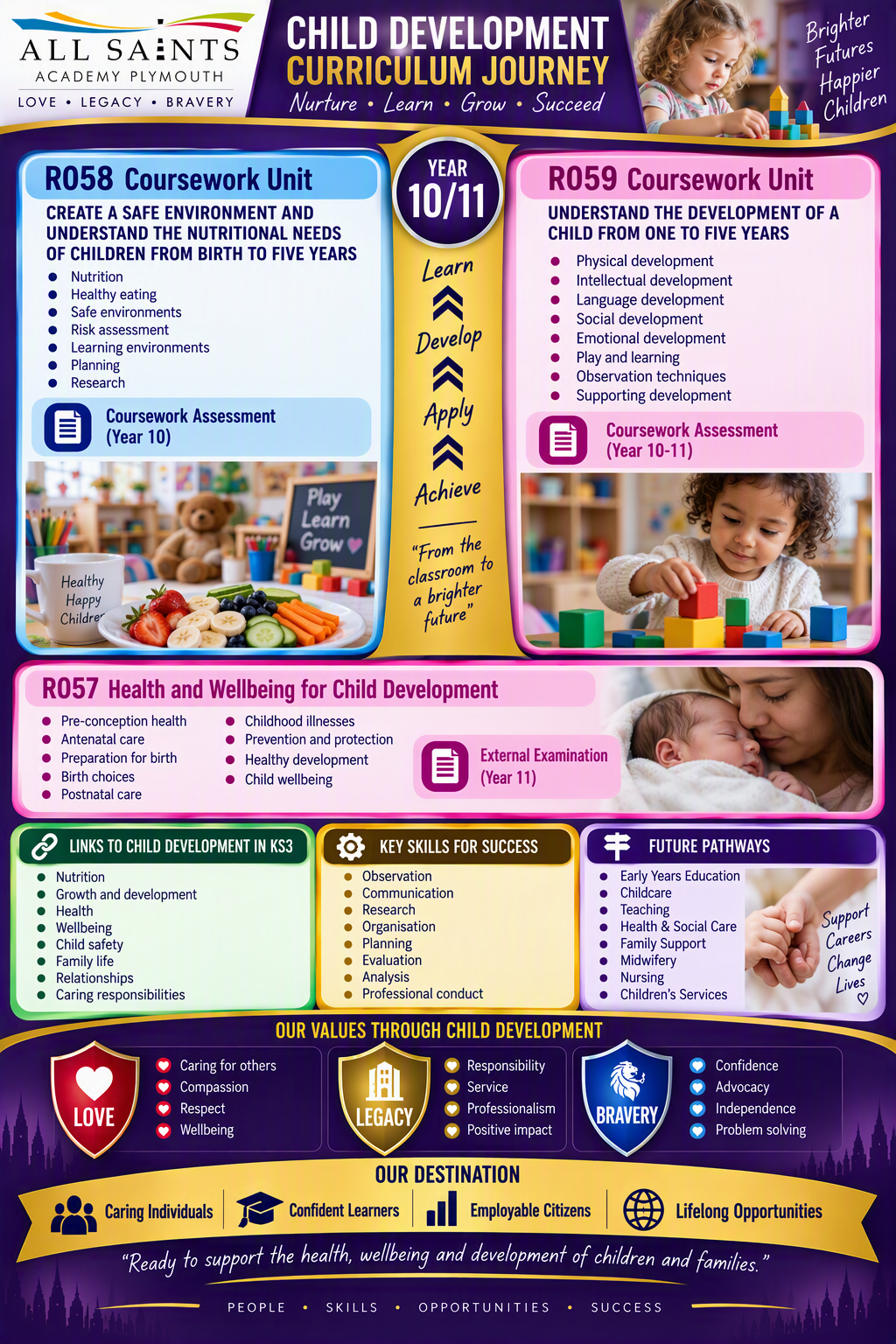
Curriculum Intent
The OCR Cambridge National in Child Development curriculum provides students with a broad and engaging understanding of child development from pre-conception through to five years of age. The course combines academic study with practical application, allowing students to develop knowledge, skills and understanding relevant to the childcare, education, health and social care sectors.
Through the study of child development, students gain an appreciation of the importance of supporting children’s physical, intellectual, social and emotional development. Learners explore how positive environments, nutrition, health promotion and effective care contribute to successful outcomes for children and families. The curriculum encourages students to become reflective, compassionate and responsible individuals who can apply their learning to real-life situations while developing transferable skills such as research, planning, evaluation, communication and problem-solving.
Our intent is to:
- Develop a secure understanding of child development from conception to five years.
- Enable students to understand the factors that influence healthy growth, development and wellbeing.
- Equip learners with the knowledge and practical skills required to create safe, stimulating and nurturing environments for children.
- Foster independence and confidence through planning, researching and evaluating coursework tasks.
- Encourage critical thinking and informed decision-making through the exploration of health, nutrition, safety and developmental needs.
- Inspire students to consider future pathways within childcare, education, health and social care professions.
- Promote the values of safeguarding, inclusion, equality and respect when working with children and families.
Impact
By the end of the course, students will have developed a secure understanding of the health, wellbeing and development of children from conception to five years. They will be able to apply theoretical knowledge to practical situations, demonstrate effective research and planning skills, and understand how safe, nurturing environments support positive outcomes for children. Students will be well-prepared for further study in Health and Social Care, Early Years Education, Childcare and related vocational pathways, as well as future careers working with children and families.
Curriculum Map
Creative i-Media
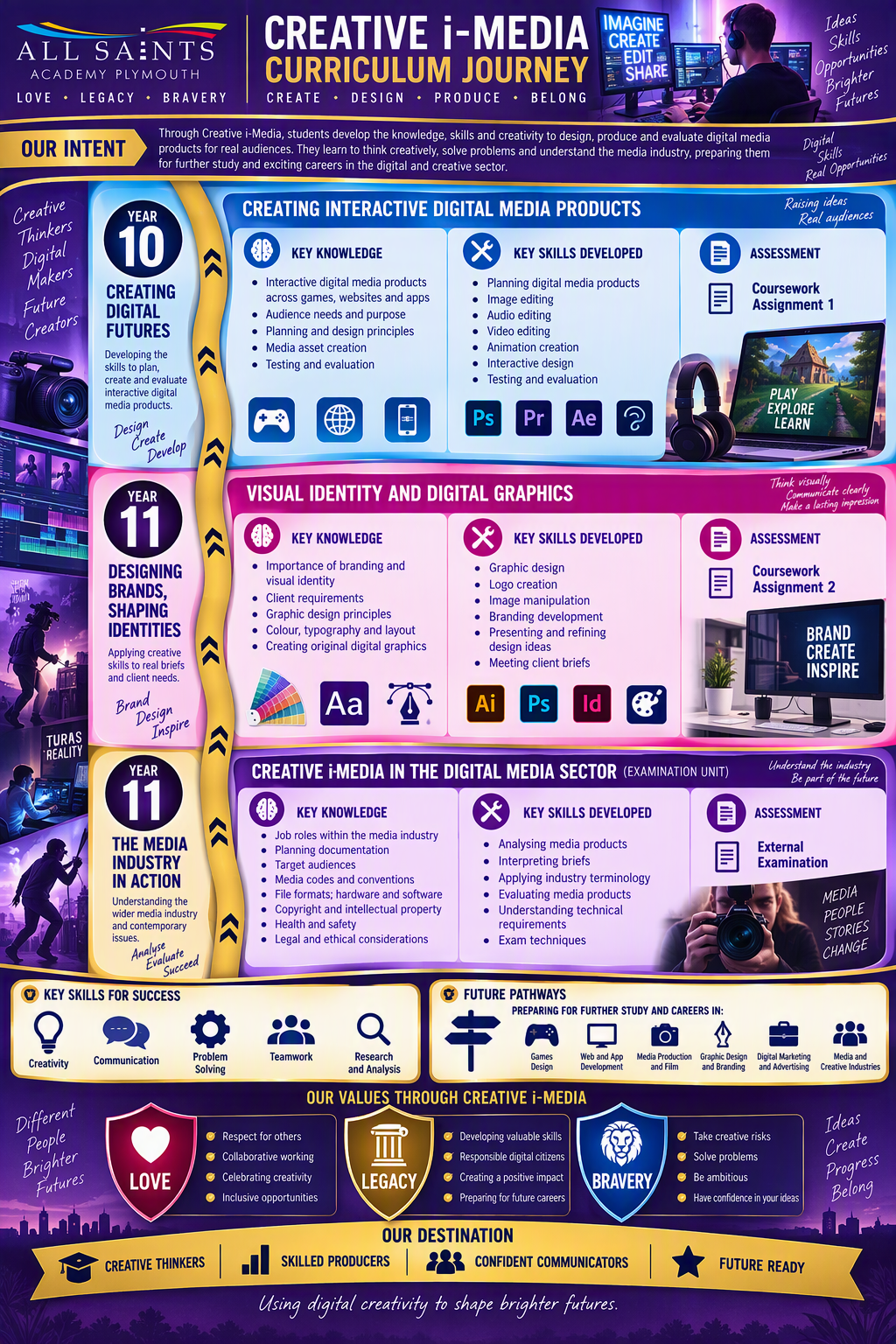
Curriculum Intent
The Creative iMedia curriculum is planned to ensure that students are enriched with a range of digital skills to be successful in life, beyond school. Students will leave us with the confidence to access and use a whole range of digital media and software applications. The Creative iMedia curriculum is designed to build upon and challenge student’s knowledge, skills and understanding of digital media concepts. Creative iMedia actively promotes innovation, creativity and strives to build independent learners. Students will study three units which aim to take students through the process of learning, developing, applying and evaluating.
The curriculum intends:
- To equip our students with practical digital media skills through assignments of real-world scenarios. These will enable our students to gain the essential transferable digital media skills and knowledge to enhance their employability within the digital media industry. The curriculum will encourage independent learning, creativity, research and digital media product creation.
- To explore how digital media is used within our society for a wide range of purposes and target audiences.
- To equip our students with an array of critical skills which include effective research, interpretation, planning, development, analysis and evaluation.
- Through all of this, to cultivate a love of the subject that propels students towards a future interest in the creative digital media industry.
Curriculum Map
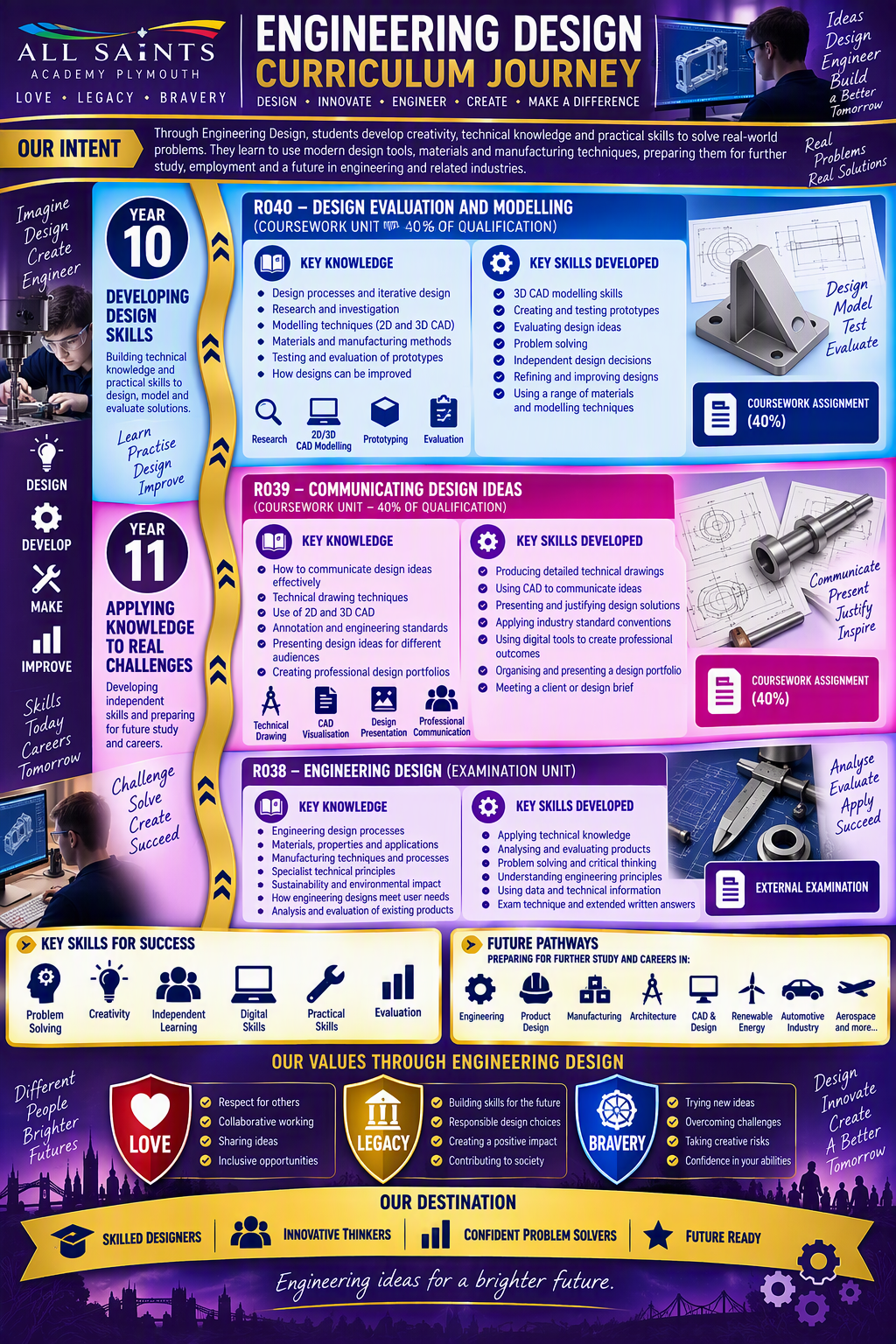
Engineering Design
Curriculum Intent
Key KnowledgePupils will know: |
Key SkillsPupils will be able to: |
|
Key Threshold Concepts
Subject Specific Knowledge – Pupils will know: Understand and apply the fundamental principles and concepts of Engineering Design, including the design process, types of drawings, influences on design, and the use of Computer Aided Design (CAD) Develop learning and practical skills that can be applied to real-life contexts and work situations Think creatively, innovatively, analytically, logically and critically. Develop independence and confidence in using skills that are relevant to the engineering design and development sector and more widely. Analyse problems in design terms through practical experience of solving such problems, including designing and modelling designs to meet a design brief. Understand the different stages of the iterative design process, recognising the cyclical nature of this approach. Evaluate designs through product disassembly and the process of using product analysis. |
Cross –Curricular Knowledge Maths – calculating area, circumference, measuring, use of CAD Science – Material properties, forces, electronics. Geography – considering different cultural needs when designing products. Considering the origins of materials and the economics of global manufacture. Sustainability. Business – Designing products for the market, economics, scales of production, client and user requirements, analysing the market. |
Curriculum Map
Health and Social Care
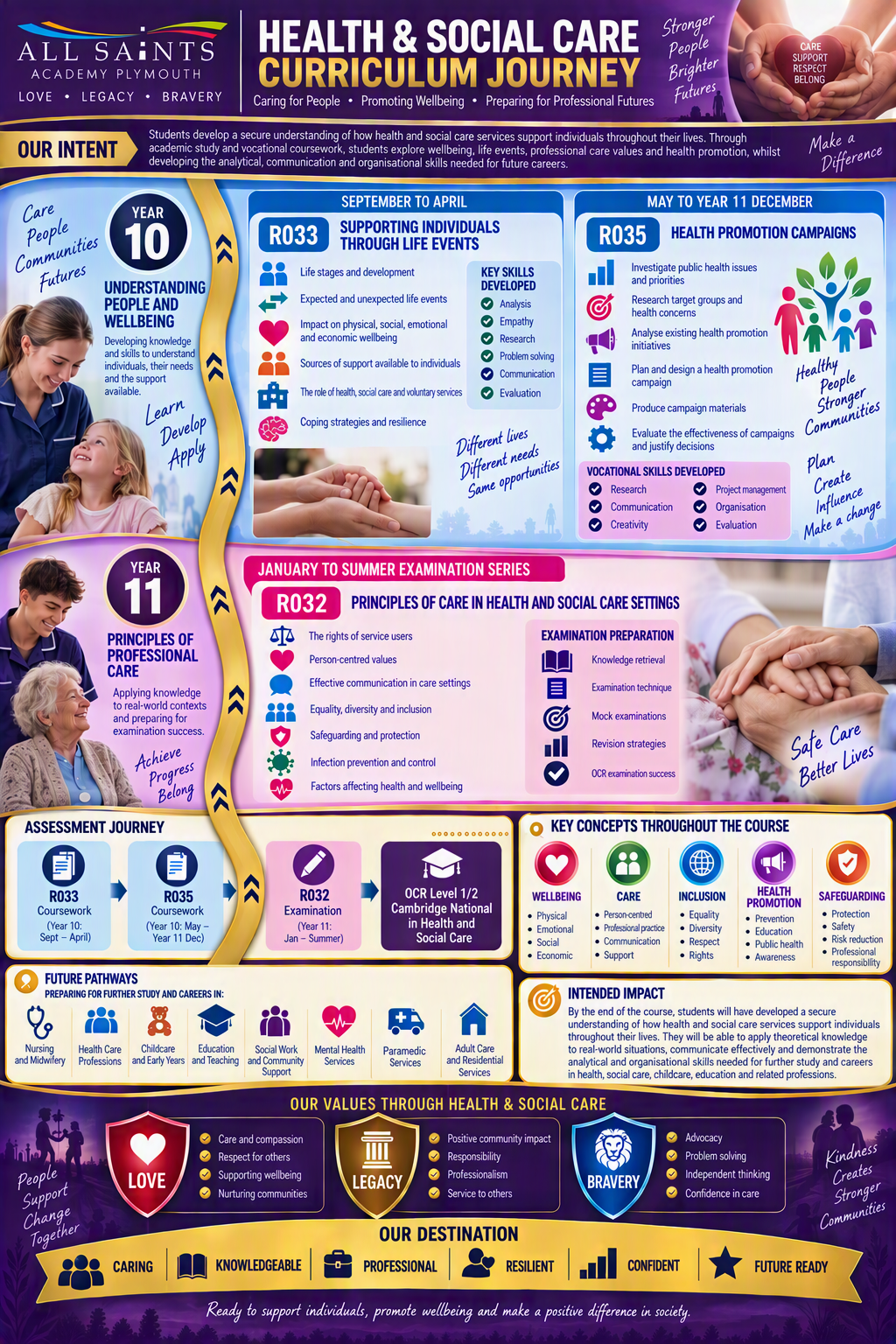
Curriculum Intent
The OCR Cambridge National in Health and Social Care curriculum provides students with the knowledge, understanding and practical skills needed to explore how individuals grow, develop and access support throughout their lives. The course enables learners to investigate the health and social care sector, develop an awareness of the factors that influence health and wellbeing, and understand how care services meet the needs of different individuals within society.
Through a combination of examined and coursework units, students develop transferable skills including research, analysis, communication, problem-solving, evaluation and independent learning. The curriculum encourages students to become compassionate, informed and reflective individuals who recognise the importance of promoting equality, diversity, inclusion and person-centred care.
Our intent is to:
- Develop students' understanding of health and social care services and their role in supporting individuals.
- Enable learners to understand human growth and development across the life stages.
- Equip students with the knowledge and skills to apply person-centred values when considering care provision.
- Foster analytical and evaluative thinking through the investigation of real-life health and social care scenarios.
- Develop independent learning, research and organisational skills through vocational coursework.
- Promote awareness of equality, diversity, safeguarding and anti-discriminatory practice.
- Inspire future careers and further study within health, social care, nursing, childcare, education and allied health professions.
- Encourage students to become responsible citizens who understand the factors influencing physical, emotional, social and intellectual wellbeing.
Impact
By the end of the course, students will have developed a secure understanding of how health and social care services support individuals throughout their lives. They will understand the principles of effective care, the impact of life events and the importance of promoting health and wellbeing within communities. Students will be able to apply their knowledge to real-world contexts, communicate effectively and demonstrate the analytical and organisational skills needed for further study and careers within health, social care, nursing, childcare, education and related professions.
Curriculum Map
Hospitality and Catering
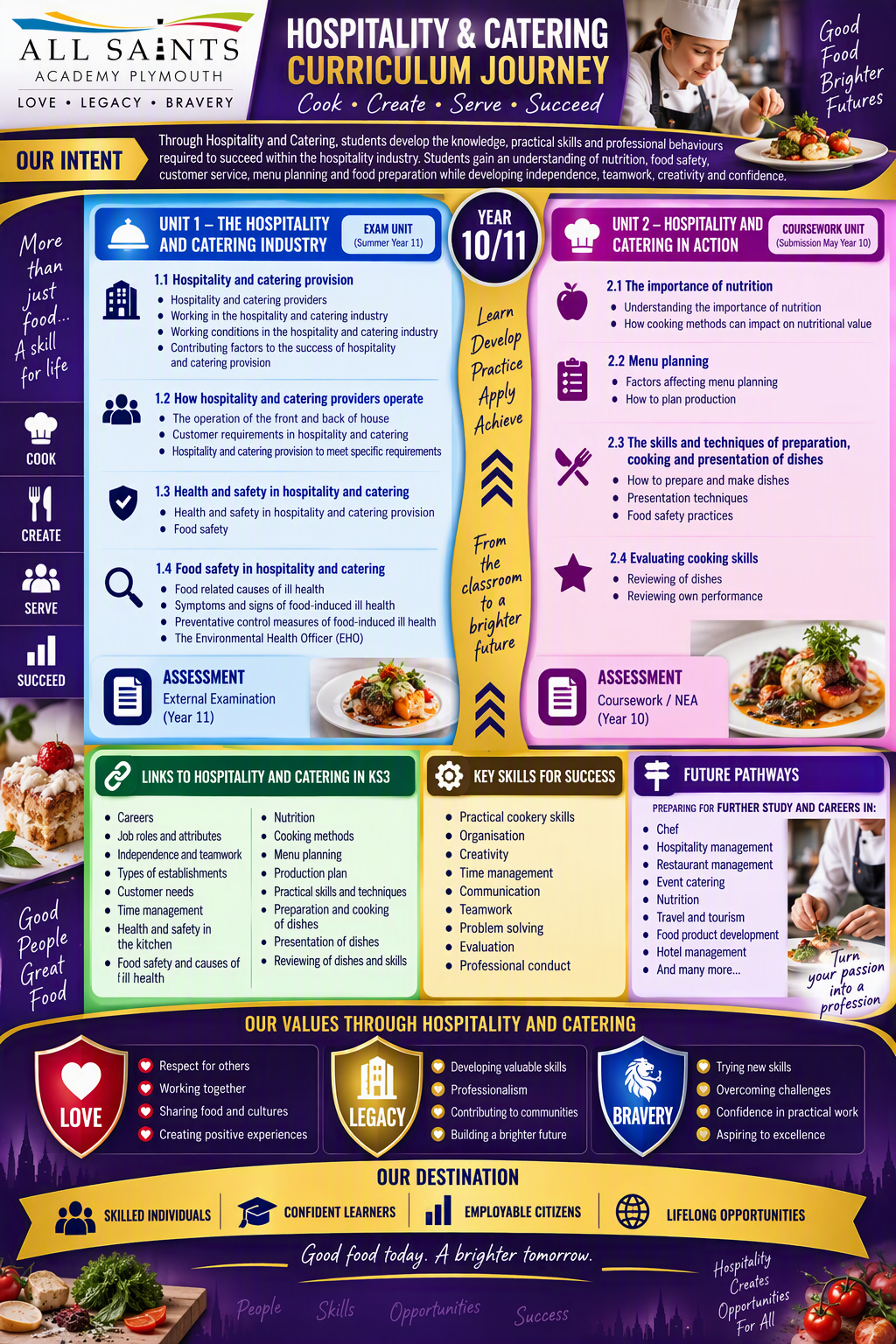
Curriculum Intent
At All Saints Academy, the Hospitality and Catering curriculum is designed to develop knowledgeable, skilled and confident learners who understand the vital role that food, nutrition and customer service play within the hospitality industry. Students gain both theoretical knowledge and practical experience, enabling them to make informed decisions, work safely and professionally, and prepare for future careers within one of the UK's largest employment sectors.
Through the Level 1/2 Award in Hospitality and Catering, students explore how hospitality and catering providers operate, the importance of customer satisfaction, and the factors that contribute to successful businesses. They develop an understanding of health, safety and food hygiene, learning how safe working practices protect both customers and staff.
Students apply their knowledge through practical cooking experiences, where they investigate nutrition, menu planning, food preparation, presentation techniques and evaluation. They learn how to plan, prepare and cook a range of dishes, demonstrating creativity, organisation, time management and attention to detail while developing confidence in a professional kitchen environment.
The curriculum encourages students to become independent, resilient and reflective learners who can evaluate their own performance, solve problems effectively and work collaboratively with others. Links to prior learning in KS3 Food Technology ensure a coherent progression of knowledge and skills, building on foundations in nutrition, food safety, practical cookery and healthy eating.
By the end of the course, students will understand the hospitality and catering industry, appreciate the importance of nutrition and food safety, and possess the practical, organisational and communication skills needed for further study and employment. They will be well prepared for future pathways in hospitality management, catering, nutrition, food development, tourism and related industries, embodying the academy values of Love, Legacy and Bravery through professionalism, teamwork, creativity and aspiration.
Intended Impact
Students leave All Saints Academy as skilled, confident and employable young people who can apply their knowledge of nutrition, food safety and hospitality operations in real-world contexts. They become independent thinkers, effective communicators and responsible citizens, equipped with the practical skills and professional attitudes required to succeed in further education, employment and lifelong learning. Through hospitality and catering, students develop the confidence to create positive experiences for others and contribute meaningfully to their communities and future workplaces.
Curriculum Map
Sports Studies
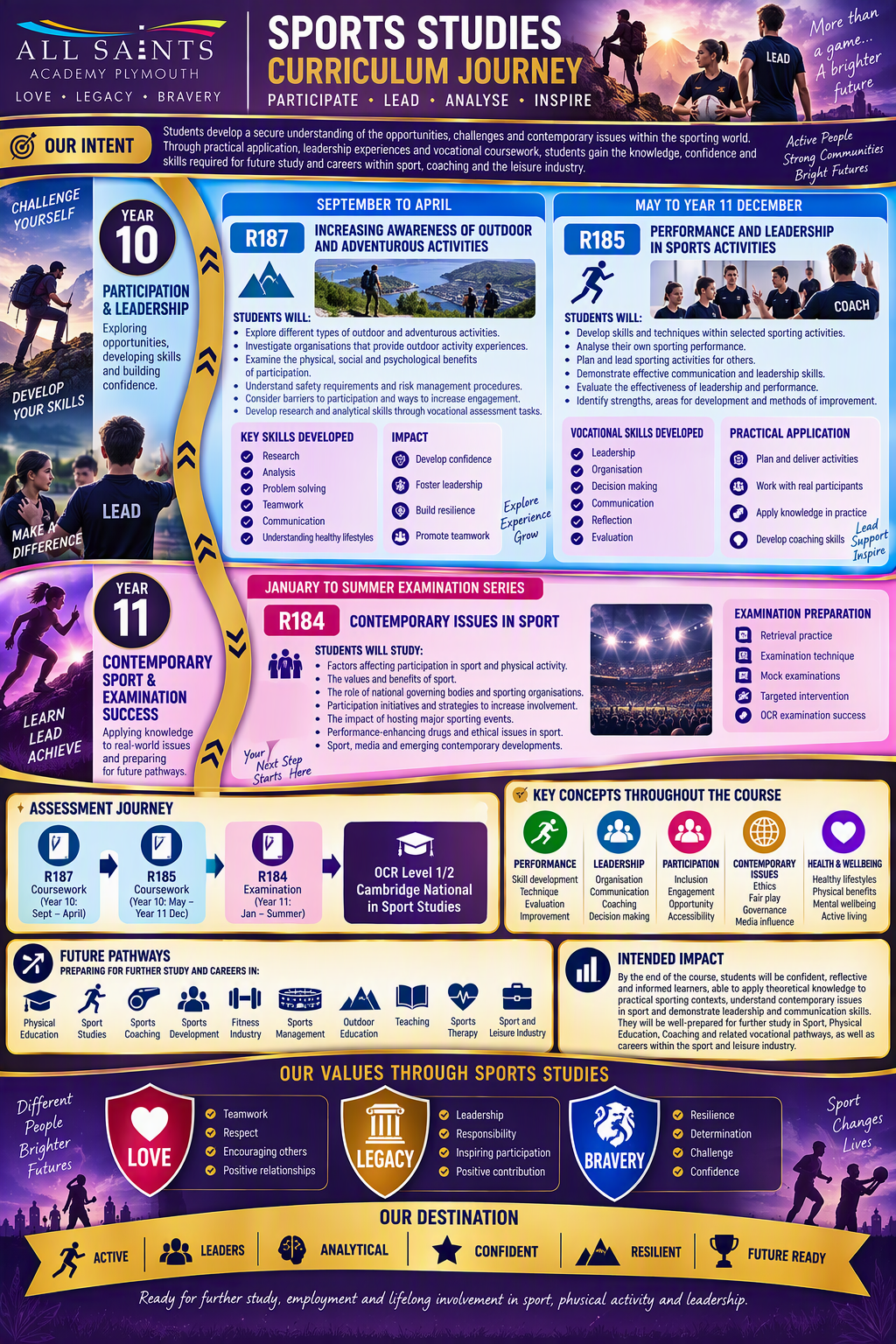
Curriculum Intent
The OCR Cambridge National in Sport Studies curriculum provides students with the opportunity to develop a broad understanding of the contemporary sports industry, the importance of participation in physical activity, and the factors that influence sporting performance. The course combines theoretical knowledge with practical application, enabling students to explore sport from both a participant and leadership perspective while developing valuable transferable skills.
Students gain an understanding of the role sport plays in promoting physical, mental and social wellbeing, whilst also examining issues such as participation, performance, leadership and safety. Through coursework and examination units, learners develop research, analytical, communication and evaluation skills that prepare them for progression to further study and careers within sport, coaching, fitness, physical education and the wider leisure industry.
Our intent is to:
- Develop students' understanding of the sporting sector and the impact of sport on individuals and society.
- Equip learners with the knowledge and skills required to participate in, lead and promote sporting activities.
- Foster confidence, resilience, teamwork and leadership through practical and theoretical learning.
- Enable students to understand the factors that affect participation, performance and engagement in sport.
- Develop analytical and evaluative skills through the investigation of sporting issues and case studies.
- Encourage lifelong participation in sport and physical activity to promote health and wellbeing.
- Prepare students for further study and careers within sport, coaching, fitness, teaching and leisure industries.
- Promote values of inclusion, fair play, respect, safeguarding and positive sporting behaviour.
Impact
By the end of the course, students will have developed a secure understanding of the opportunities, challenges and contemporary issues within the sporting world. They will be able to apply theoretical knowledge to practical sporting contexts, demonstrate leadership and communication skills, and analyse factors influencing participation and performance. Students will leave the course as confident, reflective and informed learners, well-prepared for further study in Sport, Physical Education, Coaching and related vocational pathways, as well as careers within the sport and leisure industry.
Curriculum Map
Statistics
Curriculum Intent
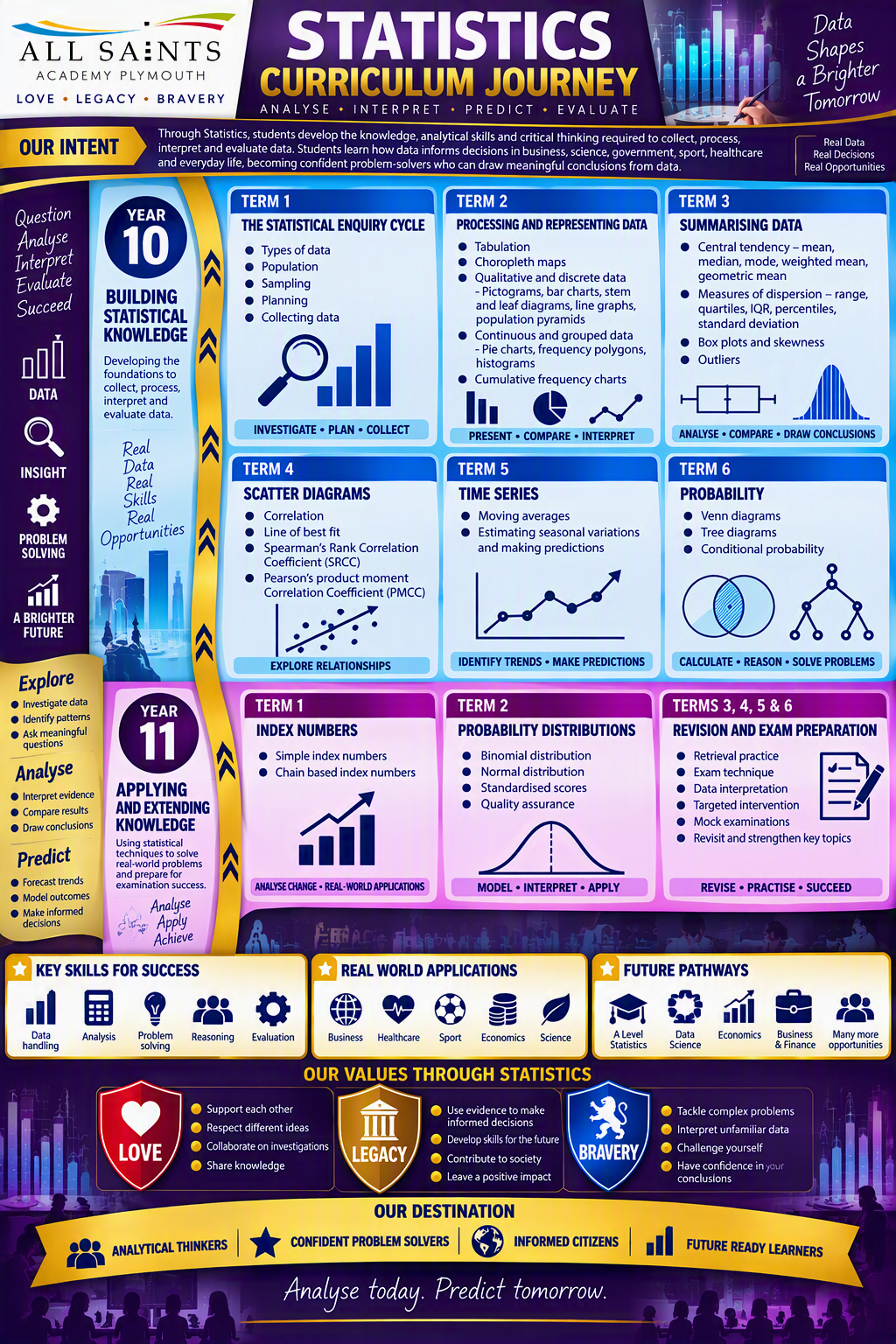
- To build statistical fluency by building confidence in collecting, processing, representing and interpreting data.
- To explore real world applications using authentic data sets from fields like science, geography, economics, business and sport.
- To develop critical thinking by evaluating the reliability and validity of data, and spotting misleading graphs or statistics.
- To provide cross-curricular support by reinforcing concepts from GCSE Mathematics and supporting subjects like psychology, sociology and the sciences.
In statistics, the work is regularly reviewed with retrieval practice in all lessons to consolidate and extend knowledge. The Scheme of Work is paused before each monitoring point to allow for thorough revision of topics studied so far. Time is taken after each monitoring point to review assessments and re-teach topics as necessary.
Curriculum Map